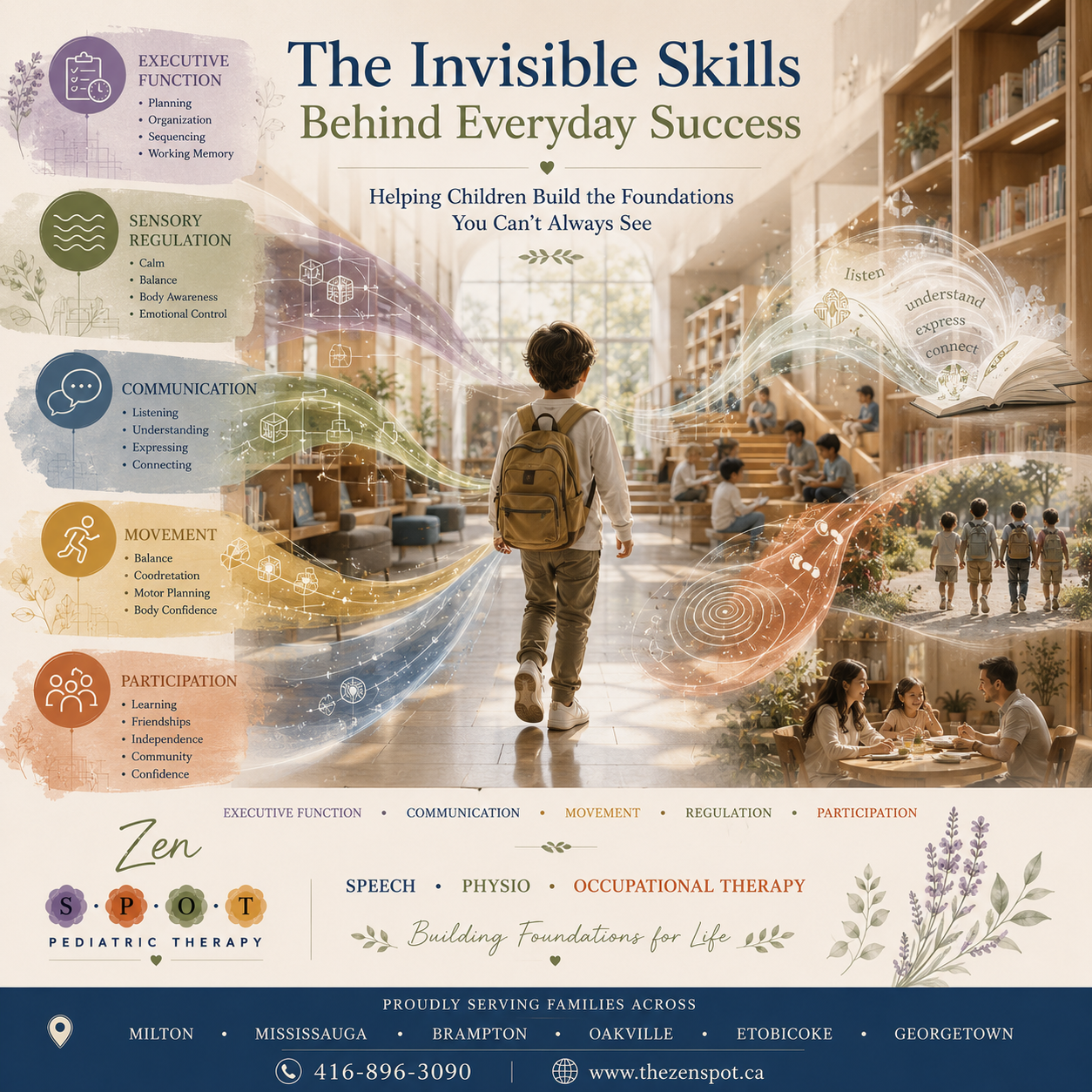
The Invisible Skills Behind Everyday Success | Zen S.P.O.T – Why Child Development Is About More Than What We Can See Every child reaches milestones in their own unique way. Parents often celebrate the visible achievements—first words, confident steps, learning to write, making friends, or participating in classroom activities. While these accomplishments are exciting, they are supported by many developmental processes that are not immediately visible. Skills such as executive function, communication, sensory regulation, movement, attention, emotional regulation, and body awareness quietly work together every day. These “invisible skills” form the foundation for learning, confidence, independence, and participation across every stage of childhood. At Zen S.P.O.T Pediatric Therapy, we believe that meaningful progress begins by understanding the whole child. Rather than focusing on isolated challenges, our multidisciplinary approach recognizes how communication, movement, sensory processing, and everyday participation are interconnected. What Are the Invisible Skills? Invisible skills are the underlying developmental abilities that support everything children do throughout the day. While they cannot be seen directly, they influence nearly every aspect of learning, behaviour, communication, and participation. These include: Together, these abilities help children navigate school, home, community activities, and relationships with confidence. Executive Function: The Brain’s Management System Executive function refers to the cognitive processes that help children plan, organize, remember instructions, manage emotions, and complete tasks. Children rely on executive function to: When executive function develops well, children become more independent and confident in everyday life. Communication Is More Than Talking Communication is about much more than saying words. Children communicate by: Strong communication skills help children build relationships, participate in the classroom, and develop confidence. Speech-Language Therapy can support children in developing communication skills that extend beyond therapy sessions into real-world interactions. Movement Supports Learning Movement and learning are closely connected. A stable body provides the foundation for: Postural control, balance, coordination, and motor planning all contribute to successful participation in everyday activities. Pediatric Physiotherapy helps children build movement skills that support lifelong confidence and independence. Sensory Regulation Shapes Everyday Participation Every child processes sensory information differently. Some children seek movement, while others may become overwhelmed by sounds, touch, busy environments, or transitions. Sensory regulation influences: Occupational Therapy helps children develop strategies that support successful participation while respecting each child’s unique sensory profile. Emotional Regulation Builds Confidence Learning to understand and manage emotions is an essential developmental skill. Children who feel regulated are often better able to: Supporting emotional regulation helps children approach everyday experiences with greater confidence and flexibility. Participation Is the Goal Parents often focus on milestones, but the ultimate goal is meaningful participation. Participation means: Therapy should support children in participating confidently in the activities that matter most to them. Why a Multidisciplinary Approach Matters Child development is interconnected. Communication influences participation. Movement supports learning. Executive function affects independence. Sensory regulation impacts emotional well-being. Because these areas work together, collaboration between disciplines is essential. At Zen S.P.O.T Pediatric Therapy, Speech-Language Pathologists, Occupational Therapists, and Pediatric Physiotherapists work together to provide coordinated, family-centred care that reflects each child’s individual strengths and needs. Supporting Children Across Everyday Environments Children do not develop skills only during therapy sessions. Development continues at: By supporting the underlying developmental skills that influence participation, therapy can help children engage more confidently across these environments. Every Child’s Journey Is Unique No two children learn or develop in exactly the same way. Some children may need additional support with: Individualized assessment helps identify each child’s strengths while creating meaningful goals that reflect their daily life. A Family-Centred Philosophy Families are an essential part of every child’s developmental journey. Our team believes in partnering with parents and caregivers by: When families feel empowered, children benefit from greater consistency across all environments. Frequently Asked Questions Why are invisible developmental skills important? Invisible skills support the visible abilities parents notice, including communication, learning, movement, social participation, and independence. Can more than one therapy discipline help my child? Many children benefit from a collaborative approach involving Speech Therapy, Occupational Therapy, and Pediatric Physiotherapy when clinically appropriate. Does therapy only focus on milestones? No. Therapy also supports participation, confidence, relationships, emotional regulation, and everyday functional skills. Which communities does Zen S.P.O.T serve? We proudly support families across: Conclusion Every confident conversation, every successful classroom experience, every new friendship, and every step toward independence is supported by countless invisible developmental skills working together. By recognizing the connection between communication, movement, executive function, sensory regulation, and participation, families gain a deeper understanding of how children grow and thrive. At Zen S.P.O.T Pediatric Therapy, our multidisciplinary team is committed to helping children build these essential foundations through individualized, evidence-informed, family-centred care. Because when the invisible skills become stronger, children are better equipped to participate confidently in the moments that matter most. Call to Action If you would like to learn more about how our multidisciplinary team can support your child’s development, we’re here to help. Zen S.P.O.T Pediatric Therapy 📍 Serving Families AcrossMilton • Mississauga • Brampton • Oakville • Etobicoke • Georgetown 📞 416-896-3090 🌐 www.thezenspot.ca Speech • Physio • Occupational Therapy Building Foundations for Life Safe & Sound Protocol (SSP): Supporting Executive Function in Children Occupational Therapy (OT) Pediatric Physiotherapy in Milton | Functional Therapy for Kids | Zen SPOT
Safe & Sound Protocol (SSP): Supporting Executive Function in Children
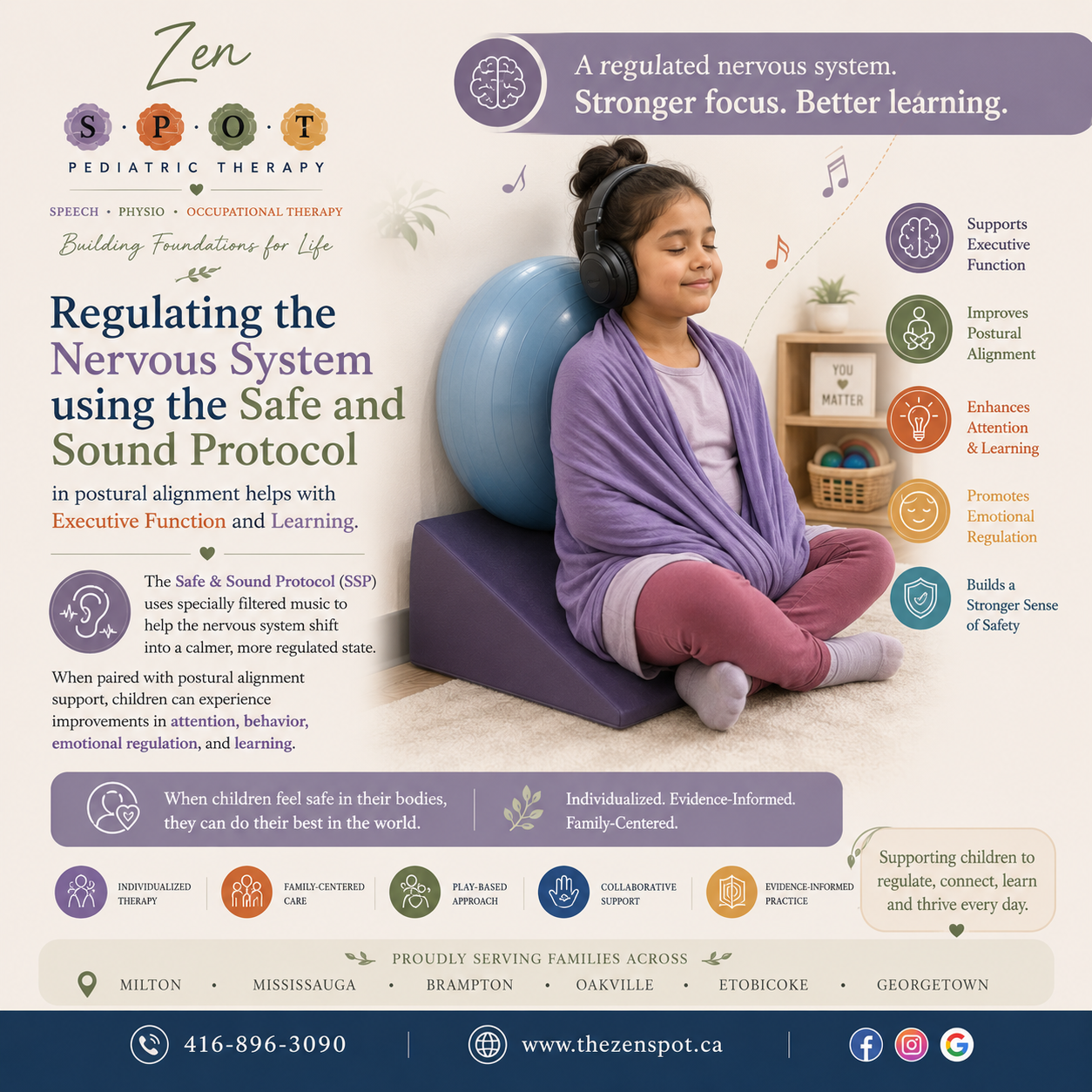
Safe & Sound Protocol | Executive Function | Zen S.P.O.T Strong Regulation Supports Better Learning: How the Safe & Sound Protocol (SSP) Helps Build Executive Function in Children Introduction Every child learns differently. While attention, planning, memory, emotional regulation, and flexible thinking are often viewed as purely cognitive skills, these abilities are closely connected to how the nervous system functions. When a child feels safe, regulated, and supported, the brain is better prepared to focus, solve problems, engage socially, and participate in everyday learning experiences. Conversely, when the nervous system is overwhelmed or constantly responding to stress, executive function skills can become more difficult to access. At Zen S.P.O.T Pediatric Therapy, we recognize that meaningful learning begins with regulation. Our individualized approach may include the Safe and Sound Protocol (SSP) alongside other therapeutic strategies, such as postural alignment and movement-based interventions, when clinically appropriate. Together, these supports help create stronger foundations for attention, participation, emotional regulation, and everyday success. What Is the Safe and Sound Protocol? The Safe and Sound Protocol (SSP) is an evidence-informed listening intervention developed from Polyvagal Theory, which explores how the autonomic nervous system influences our sense of safety, connection, and engagement. Using specially filtered music delivered through headphones, the SSP is designed to support nervous system regulation. Sessions are guided and individualized, with pacing adjusted according to each child’s unique responses and therapeutic needs. The goal is not simply to listen to music—it is to help create conditions where the nervous system can better support learning, communication, emotional regulation, and participation in daily life. Understanding Executive Function Executive function refers to a group of cognitive skills that help children manage everyday tasks and adapt to changing situations. These skills include: These abilities influence how children participate at home, in school, during play, and within their community. Why Regulation Comes Before Learning Children are not expected to perform at their best when they feel unsafe or overwhelmed. When the nervous system is dysregulated, the brain often prioritizes protection over higher-level thinking. This can affect a child’s ability to: Supporting regulation helps create an environment where executive function skills can develop more effectively. The Connection Between Postural Alignment and Learning Learning involves much more than cognitive ability alone. Postural stability provides a physical foundation that allows children to direct their attention toward learning rather than maintaining balance or managing inefficient movement patterns. Good postural control supports: Movement quality and regulation often work together to support successful participation. How the Safe and Sound Protocol Complements Therapy At Zen S.P.O.T Pediatric Therapy, every child receives an individualized treatment plan. When clinically appropriate, the Safe and Sound Protocol may be integrated alongside other interventions, including: This collaborative approach recognizes that development is interconnected. Individualized Care Matters No two children have identical developmental profiles. Some children may experience: Because every child is unique, therapy should always be tailored to their individual strengths, needs, and goals. Supporting Everyday Participation Executive function is not only about academic performance. These skills influence everyday participation, including: Our goal is to support meaningful participation across all environments. A Collaborative Approach Meaningful progress often occurs when everyone works together. Our team collaborates with: Collaboration helps ensure strategies remain consistent across home, school, and community settings. Why Families Choose Zen S.P.O.T Pediatric Therapy Families choose Zen S.P.O.T because we focus on the whole child rather than isolated symptoms. Our approach emphasizes: Every therapeutic recommendation is designed to support long-term success in real-life environments. Frequently Asked Questions Can SSP improve executive function? The Safe and Sound Protocol is designed to support nervous system regulation. Improved regulation may help create conditions that support executive function, attention, emotional regulation, and participation. Individual outcomes vary. Is SSP appropriate for every child? Not necessarily. Suitability should always be determined through an individualized assessment conducted by qualified professionals. Can SSP be combined with Occupational Therapy or Physiotherapy? Yes. When clinically appropriate, SSP may complement Occupational Therapy, Pediatric Physiotherapy, Speech-Language Therapy, and other evidence-informed interventions as part of a comprehensive treatment plan. Where is Zen S.P.O.T located? Zen S.P.O.T proudly supports families throughout: Final Thoughts Learning is built on more than academic instruction—it begins with a nervous system that feels regulated, supported, and ready to engage. By taking a whole-child approach that may include the Safe and Sound Protocol alongside individualized therapeutic interventions, Zen S.P.O.T Pediatric Therapy helps children build stronger foundations for attention, emotional regulation, participation, and lifelong learning. Every child deserves the opportunity to reach their potential through care that is compassionate, collaborative, and evidence-informed. Call to Action If you would like to learn more about the Safe and Sound Protocol (SSP) or how our multidisciplinary team supports children’s development, contact Zen S.P.O.T Pediatric Therapy. 📍 Serving Milton, Mississauga, Brampton, Oakville, Etobicoke & Georgetown 📞 416-896-3090 🌐 www.thezenspot.ca Speech • Physio • Occupational Therapy Building Foundations for Life Safe and Sound Protocol
Freedom to Move | Infant Development Guide | Zen S.P.O.T Pediatric Therapy
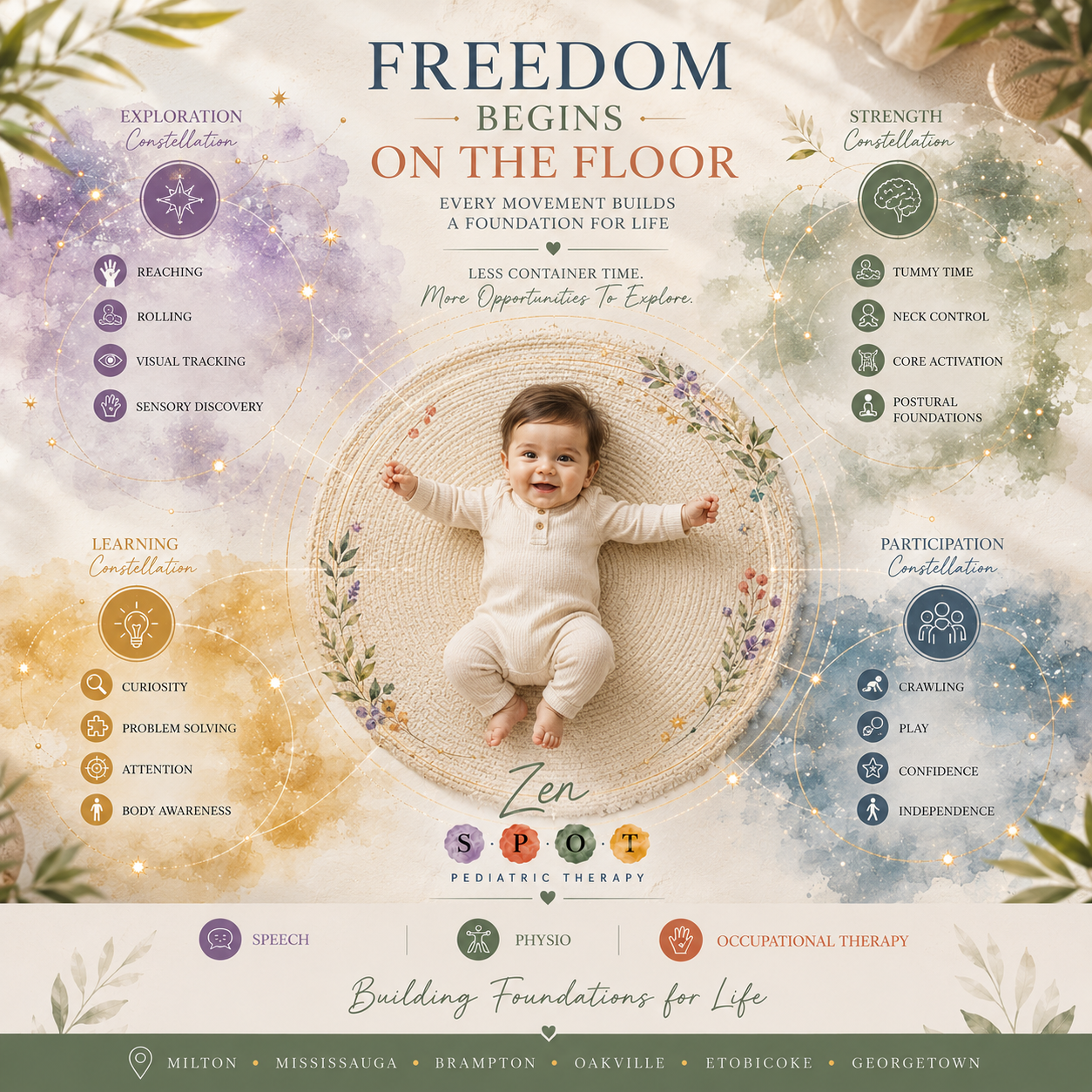
Freedom to Move | Infant Development Guide | Zen S.P.O.T Pediatric Therapy : Freedom to Move: Why Natural Movement Is the Foundation of Healthy Infant Development Modern Parenting and the Rise of Container Culture Parents today have access to more baby products than ever before. Swings, loungers, bouncers, molded seats, activity centers, walkers, and high-tech infant gear promise convenience and developmental benefits. While many of these products can be helpful in moderation, research continues to emphasize one important principle: Babies develop through movement. The first year of life lays the foundation for strength, coordination, balance, sensory processing, motor planning, and future participation in everyday activities. Why Floor Time Matters Floor time provides infants with opportunities to: Unlike containers that restrict movement, floor play allows babies to learn through exploration. At Zen S.P.O.T Pediatric Therapy, we often remind families that movement is one of a child’s earliest teachers. The Benefits of Tummy Time Tummy time remains one of the most important developmental activities during infancy. Benefits include: Neck Strength Development Tummy time strengthens muscles responsible for head control and postural stability. Core Activation Strong abdominal and trunk muscles provide the foundation for future movement skills. Motor Skill Development Rolling, crawling, sitting, and walking all begin with foundational strength developed during tummy time. Flat Head Prevention Tummy time reduces pressure on the back of the skull and supports healthy head shape development. Understanding Container Time Containers include: These products can be useful tools but should not become a baby’s primary environment. Excessive container use may contribute to: Flat Head Prevention and Healthy Positioning Positional plagiocephaly, often called flat head syndrome, has become increasingly common. Fortunately, prevention strategies are simple: Safe sleep should always remain the priority. Babywearing as a Developmental Tool Babywearing offers several developmental benefits: Babywearing should complement, not replace, opportunities for independent floor exploration. Walking Development: Why Barefoot Is Often Best One of the biggest misconceptions is that babies need supportive shoes to learn how to walk. Research suggests that barefoot exploration often provides the best sensory feedback and movement opportunities. When shoes are required, look for: The Truth About Baby Walkers Many parents believe walkers help babies walk sooner. Research suggests otherwise. Traditional walkers may: Push walkers and natural exploration opportunities are generally preferred. Choosing Development-Friendly Toys The best toys often support: Open-ended toys such as blocks, balls, stacking cups, pretend play items, and books often provide greater developmental value than highly stimulating electronic toys. When Should Parents Seek Professional Advice? Consider consulting a pediatric therapist if your child demonstrates: Early support often leads to the best outcomes. Building Foundations for Life Healthy development is not about expensive equipment or achieving milestones quickly. It is about providing opportunities for movement, exploration, interaction, and learning. At Zen S.P.O.T Pediatric Therapy, our team of Pediatric Physiotherapists, Occupational Therapists, and Speech-Language Pathologists helps families support development through evidence-based, child-centered care. Because every child deserves the opportunity to build strong foundations for confidence, participation, and lifelong success. Speech • Physio • Occupational TherapyBuilding Foundations for LifeServing Milton, Mississauga, Brampton, Oakville, Etobicoke & Georgetown Schedule a Free Consultation
What to Expect During SSP Sessions | Safe & Sound Protocol | Zen S.P.O.T
What to Expect During SSP Sessions | Safe & Sound Protocol | Zen S.P.O.T What to Expect During Safe & Sound Protocol (SSP) Sessions The Safe & Sound Protocol (SSP) is an evidence-based listening intervention designed to support nervous system regulation, emotional resilience, sensory processing, and social connection. Developed by Dr. Stephen Porges and grounded in Polyvagal Theory, SSP uses specially filtered music to help the brain and body recognize cues of safety, supporting a greater sense of calm, regulation, and connection. One of the most common questions families ask is: “What actually happens during an SSP session?” At Zen S.P.O.T Pediatric Therapy, SSP is delivered through a personalized, trauma-informed approach that respects the unique needs and experiences of every individual. Understanding the Safe & Sound Protocol The SSP is not simply a music program. It is a structured therapeutic intervention that uses specially filtered music designed to engage neural pathways associated with listening, social engagement, emotional regulation, and nervous system functioning. The goal is not to force change but to support the nervous system’s capacity for regulation, flexibility, and connection. Step 1: Initial Assessment and Preparation Every SSP journey begins with an intake process. During this stage, we gather information about: This information helps us determine the most appropriate pacing and support strategies throughout the process. Because every nervous system is different, personalization is a critical component of successful SSP implementation. Step 2: Guided Listening Sessions The core SSP program consists of approximately five hours of specially filtered music delivered over time. Listening sessions are carefully monitored and adjusted based on the individual’s responses. The goal is to support regulation rather than overwhelm the nervous system. Sessions may be modified through: This flexibility helps create a supportive therapeutic experience that respects the individual’s comfort level and regulation capacity. Step 3: Regulation and Integration Support Listening is only one part of the process. At Zen S.P.O.T, we emphasize integration and nervous system support throughout the SSP journey. This may include: Integration helps individuals transfer regulation skills into everyday life situations. Who May Benefit from SSP? The Safe & Sound Protocol may be considered for individuals experiencing: Suitability should always be determined through individualized assessment and professional guidance. A Trauma-Informed Approach Matters At Zen S.P.O.T Pediatric Therapy, we recognize that healing occurs within a sense of safety. Our trauma-informed approach prioritizes: The goal is to create an environment where clients feel supported, understood, and empowered throughout the process. Integrating SSP with Other Supports The Safe & Sound Protocol can complement a variety of therapeutic approaches, including: An integrated approach often helps individuals build lasting skills that support daily participation and well-being. Why Families Choose Zen S.P.O.T for SSP Families often seek SSP because they are looking for support that goes beyond symptom management. They want tools that help improve regulation, connection, resilience, and participation in everyday life. Our team provides a personalized, compassionate, and evidence-informed approach designed to meet individuals where they are and support meaningful progress over time. Because every nervous system deserves the opportunity to experience greater calm, connection, and flexibility. Speech • Physio • Occupational Therapy Building Foundations for Life Schedule a Free Consultation Read our Blogs and Articles
Container Time vs Floor Time | Infant Development Tips | Zen S.P.O.T
Container Time vs Floor Time | Infant Development Tips | Zen S.P.O.T Learn how tummy time, floor play, and free movement support infant development. Discover the impact of container overuse and how to encourage healthy motor milestones. Container Time vs Floor Time: Why Movement Matters for Infant Development Modern parenting comes with no shortage of baby products designed to make life easier. Swings, bouncers, infant seats, loungers, jumpers, and activity centers are marketed as convenient tools for soothing, entertaining, and supporting babies during the first year of life. While these products can certainly have a place in everyday family life, pediatric professionals are increasingly raising awareness about an important developmental concept: babies learn through movement. At Zen S.P.O.T Pediatric Therapy, we frequently talk with families about the balance between convenience and development. The goal is not to eliminate baby gear entirely. Instead, it is to ensure that infants have enough opportunities to move, explore, and interact with their environment naturally. What Is Container Time? Container time refers to any period when a baby is placed in equipment that restricts movement and holds them in a fixed position. Examples include: These tools are often useful for short periods and can help caregivers manage daily routines safely. Problems typically arise when containers become a baby’s primary environment rather than a temporary support. Why Movement Matters Movement is one of the primary ways infants learn about themselves and the world around them. Through movement, babies develop: These foundations support future developmental milestones including sitting, crawling, standing, walking, and participation in everyday activities. The Benefits of Floor Time Floor time allows babies to move freely and practice important developmental skills. Benefits include: Improved Gross Motor Development Floor play encourages rolling, reaching, pivoting, crawling, and weight shifting. Better Core Strength Natural movement challenges the muscles of the neck, trunk, shoulders, and hips. Enhanced Sensory Exploration Babies learn through touch, movement, visual exploration, and interaction with their environment. Stronger Problem-Solving Skills Movement encourages curiosity, exploration, and learning. Reduced Risk of Flat Head Syndrome Changing positions regularly helps reduce prolonged pressure on the back of the head. The Connection Between Container Overuse and Development Research and clinical experience increasingly suggest that prolonged container use may contribute to: This does not mean containers are harmful when used appropriately. Rather, balance is important. Tummy Time: The Developmental Gold Standard Tummy time remains one of the most effective ways to support infant development. Benefits include: Parents often find success by incorporating short, frequent tummy time sessions throughout the day. Practical Tips for Families Healthy movement habits can be encouraged by: The goal is not perfection but creating opportunities for movement throughout the day. Building Foundations for Life Infant development does not require expensive gadgets or highly structured programs. What babies need most are opportunities to move, explore, interact, and learn through experience. At Zen S.P.O.T Pediatric Therapy, we believe strong foundations are built through movement, connection, and participation. By prioritizing floor time, tummy time, and responsive caregiving, families can support healthy development and lifelong learning. Speech • Physio • Occupational Therapy Building Foundations for Life Schedule a Free Consultation Read more
Why Posture Matters for Speech Development: The Missing Piece Many Parents Overlook
Why Posture Matters for Speech Development: The Missing Piece Many Parents Overlook Why Posture Matters for Speech Development | Zen S.P.O.T Pediatric Therapy When parents think about speech development, they often focus on words, sounds, vocabulary, and language milestones. Few realize that one of the most important foundations for communication begins long before a child says their first sentence. It begins with the body. At Zen S.P.O.T Pediatric Therapy, we believe communication is not an isolated skill. Speech develops alongside movement, sensory processing, body awareness, motor planning, regulation, and physical development. This whole-child perspective helps us understand why some children may struggle with communication even when the challenge does not appear to be directly related to speech. A growing body of research continues to explore how physical development and communication are interconnected. While posture does not cause speech delays, the systems that support posture and communication often develop together. Speech Is More Than Just Talking Speech is one of the most complex motor tasks children perform every day. To communicate clearly, children must coordinate: When we look at communication through this lens, it becomes clear that speech is not simply a function of the mouth. The entire body contributes to successful communication. Why Stability Matters Imagine trying to write neatly while balancing on a moving surface. Before your hand can perform precise movements, your body must first establish stability. Speech works in a very similar way. Before the tongue, lips, and jaw can create accurate speech sounds, the body requires a stable foundation. Children rely on core strength, head control, neck stability, shoulder stability, and postural alignment to support the small, precise movements required for communication. As children learn to roll, sit, crawl, stand, and explore their environment, they are also developing foundational systems that support future speech and language development. The Relationship Between Posture and Breathing Every spoken word begins with airflow. Without efficient breathing patterns, children may experience: Posture plays a significant role in how efficiently a child breathes. Children who consistently sit in slumped positions may demonstrate shallow breathing patterns, reduced diaphragm activation, increased muscle tension, and less efficient respiratory control. Optimal alignment helps support breathing efficiency, providing the airflow needed for speech production. Head, Neck and Jaw Alignment The head, neck, jaw, and oral structures function as one interconnected system. When alignment is compromised, it may influence: Children with low muscle tone or postural challenges may work harder to maintain optimal positioning during communication tasks. This is one reason why collaborative care can be so beneficial. While Speech-Language Pathologists focus on communication goals, Occupational Therapists and Physiotherapists may help address postural, sensory, and movement-related factors that support communication success. The Connection Between Feeding and Speech Many parents do not realize that feeding and speech share many of the same anatomical structures. Children use their tongue, lips, jaw, cheeks, and breath support systems for both eating and speaking. Difficulties with posture during meals can sometimes impact: Because feeding and communication are closely connected, addressing foundational skills may benefit both areas simultaneously. Sensory Processing and Communication Posture is not only influenced by muscles and movement. Sensory processing also plays an important role. Some children constantly seek movement while others avoid certain positions or activities. Sensory challenges may affect: When children are using significant energy simply to remain organized and upright, fewer resources may be available for communication and learning. This is why sensory regulation is often an important consideration during developmental assessments. Signs Parents May Notice Every child develops differently, but some observations may suggest that foundational systems deserve further evaluation. Parents may notice: These signs do not automatically indicate a speech disorder. However, they may provide valuable information when examining a child’s overall developmental profile. Why Collaborative Care Matters Traditional therapy models often focus on isolated skills. At Zen S.P.O.T, we recognize that children do not develop in isolated systems. Our collaborative model brings together: Speech-Language Pathology Supporting communication, language, speech sounds, social communication, feeding, and AAC. Occupational Therapy Supporting sensory regulation, body awareness, attention, self-care skills, and functional participation. Pediatric Physiotherapy Supporting posture, alignment, core strength, movement efficiency, and physical development. When professionals communicate regularly and work toward shared goals, children benefit from a more coordinated and meaningful therapy experience. Building Foundations for Life One of the most important lessons for families is that communication development extends beyond words alone. Strong communication skills are supported by: At Zen S.P.O.T Pediatric Therapy, our philosophy is built around helping children develop strong foundations that support lifelong learning, participation, independence, and communication. When foundational systems work together effectively, children are often better positioned to communicate with greater confidence and success. Final Thoughts Speech development is about far more than sounds and words. Communication is built on the integration of physical, sensory, cognitive, emotional, and social systems. While posture may not be the first thing parents associate with speech therapy, it often plays an important supporting role in communication development. By looking beyond symptoms and understanding the whole child, families gain a clearer picture of what may be influencing their child’s communication journey. At Zen S.P.O.T Pediatric Therapy, we believe every child deserves a comprehensive, collaborative approach that helps them build the foundations necessary to thrive. Because communication is not built in isolation—it is built on the strength of the whole child. ” TALK TO US “
Pediatric Pelvic Floor Physiotherapy in Milton | Bedwetting, Constipation & Toilet Training Support | Zen S.P.O.T
Pediatric Pelvic Floor Physiotherapy in Milton | Bedwetting, Constipation & Toilet Training Support | Zen S.P.O.T Building Confidence Through Pediatric Pelvic Floor Physiotherapy Many parents are surprised to learn that challenges such as constipation, bedwetting, daytime accidents, and toilet training difficulties are often connected to how a child’s bladder, bowel, pelvic floor muscles, posture, breathing, movement patterns, and nervous system work together. While occasional accidents can be a normal part of childhood development, persistent concerns may impact a child’s confidence, participation in school activities, sleep quality, social experiences, and overall well-being. At Zen S.P.O.T Pediatric Therapy, we provide specialized Pediatric Pelvic Floor Physiotherapy in Milton and surrounding communities to help children develop healthy bladder and bowel habits, improve body awareness, and gain greater independence in everyday life. Our goal is simple: help children feel confident, comfortable, and successful while supporting families with practical strategies that work in real-world environments. What Is Pediatric Pelvic Floor Physiotherapy? Pediatric Pelvic Floor Physiotherapy is a specialized area of physiotherapy that focuses on the muscles, movement patterns, and body systems involved in bladder and bowel function. The pelvic floor is a group of muscles located at the base of the pelvis. These muscles play an important role in: When these systems are not working together efficiently, children may experience challenges such as constipation, urinary urgency, accidents, withholding behaviors, or difficulties during toilet training. Through assessment and individualized intervention, Pediatric Pelvic Floor Physiotherapy helps identify contributing factors and develop strategies that support long-term success. Common Challenges We Help Address At Zen S.P.O.T, our Pediatric Physiotherapists support children experiencing: Constipation Constipation is one of the most common pediatric health concerns and is often overlooked as a contributing factor to bladder and bowel difficulties. Symptoms may include: Addressing constipation can significantly improve a child’s comfort and daily functioning. Bedwetting (Nocturnal Enuresis) Bedwetting can be frustrating for both children and parents. While many children eventually outgrow bedwetting, persistent nighttime accidents may benefit from professional assessment and support. Our approach focuses on identifying contributing factors and helping families implement supportive strategies that encourage progress without shame or pressure. Daytime Accidents Frequent urinary accidents during the day may affect confidence, classroom participation, and social interactions. Potential contributing factors can include: A comprehensive assessment helps determine the underlying factors influencing daytime accidents. Toilet Training Challenges Every child develops at their own pace. Some children may experience difficulties with: Our therapists help create individualized strategies tailored to each child’s developmental needs. Looking Beyond Symptoms At Zen S.P.O.T, we do not simply focus on accidents or toileting behaviors. We take a whole-child approach that considers: Posture and Movement Posture influences how the pelvic floor muscles function. Poor positioning during sitting, toileting, and daily activities may contribute to bladder and bowel challenges. Breathing Patterns The diaphragm and pelvic floor work together as part of a coordinated system. Breathing mechanics can influence pressure management, muscle activation, and continence. Core Strength and Stability Core muscles provide important support for posture, movement, and pelvic floor function. Sensory Processing Some children have difficulty recognizing or responding to body signals related to bladder and bowel needs. Sensory processing considerations often play an important role in treatment planning. Daily Routines and Habits Consistent routines can help children develop healthy bladder and bowel habits that support long-term success. Our Family-Centered Approach At Zen S.P.O.T Pediatric Therapy, we believe successful outcomes happen when families are actively involved in the process. Our therapists work closely with parents and caregivers to provide: We understand that every family is unique. That’s why interventions are designed to fit naturally into daily routines rather than creating additional stress or unrealistic expectations. The Importance of Confidence and Emotional Well-Being Children experiencing toileting challenges may feel embarrassed, frustrated, or discouraged. Our approach prioritizes emotional safety and confidence-building. We focus on: Rather than focusing on accidents, we help children build confidence through small, meaningful successes. Collaborative Care at Zen S.P.O.T One of the key differences at Zen S.P.O.T is our multidisciplinary model. Children may benefit from collaboration between: This collaborative approach helps ensure that strategies are carried across all environments, including home, school, and community settings. When therapists communicate and align goals, children often experience more consistent and meaningful progress. Why Early Support Matters Early identification and intervention can help prevent challenges from becoming more complex over time. Addressing concerns early may help improve: Most importantly, early support empowers children to develop lifelong healthy habits. Why Families Choose Zen S.P.O.T Families throughout Milton and the GTA choose Zen S.P.O.T because of our commitment to: Individualized Care Evidence-Based Practice Family-Centered Support Multidisciplinary Collaboration Functional Real-Life Outcomes Child-Friendly Approach Focus on Confidence and Independence We believe therapy should help children succeed not only during appointments but also in everyday life. Serving Families Across the GTA Zen S.P.O.T Pediatric Therapy proudly supports children and families throughout: Whether your child is experiencing constipation, bedwetting, daytime accidents, or toilet training challenges, our team is here to help. Book a Pediatric Pelvic Health Assessment If you’re concerned about your child’s bladder or bowel health, know that support is available. Early intervention can make a meaningful difference in your child’s confidence, independence, and overall well-being. Contact Zen S.P.O.T Pediatric Therapy today to learn more about our Pediatric Pelvic Floor Physiotherapy services. 416-896-3090 www.thezenspot.ca Zen S.P.O.T Pediatric Therapy Speech • Physio • Occupational Therapy Building Foundations for Life Learn More Get a Free Consultation
Pediatric Physiotherapy in Milton | Functional Therapy for Kids | Zen SPOT
Pediatric Physiotherapy in Milton | Functional Therapy for Kids | Zen SPOT : Pediatric Physiotherapy That Goes Beyond Milestones At Zen SPOT, Pediatric Physiotherapy is about far more than exercises, stretches, or checking off developmental milestones. While traditional physiotherapy often focuses primarily on strengthening muscles or improving gross motor skills, our philosophy looks deeper — at the whole child. Every movement, behavior, emotion, sensory response, and daily activity is interconnected. Children do not function in isolated systems, and therapy should not treat them that way either. That is why Zen SPOT takes a comprehensive, function-based approach to Pediatric Physiotherapy that focuses on helping children succeed not only in therapy sessions, but in everyday life. Serving families across Milton, Mississauga, Brampton, Oakville, Etobicoke, and Georgetown, our multidisciplinary team helps children build the confidence, independence, and functional skills needed to thrive across home, school, play, and community environments. Why Traditional Pediatric Physiotherapy Models Often Miss the Bigger Picture Many therapy models focus primarily on isolated movement goals: While these goals are important, they only represent one part of a child’s development. At Zen SPOT, we recognize that movement is connected to: For example, a child struggling with posture and breath control may also experience: Instead of treating these challenges separately, we assess how the body functions as an integrated system. This allows us to identify the root causes behind movement difficulties and create realistic, meaningful interventions that support long-term success. Our Full-Body Functional Approach to Pediatric Physiotherapy At Zen SPOT, therapy is designed to improve how children function in their real lives — not just how they perform during therapy sessions. Our Pediatric Physiotherapy programs focus on: Posture and Breath Control Strong posture and effective breathing patterns support: By improving postural control and breathing mechanics, children are often better able to participate in school, sports, play, and daily activities. Sensory Regulation Children who struggle with sensory processing may experience: We integrate sensory regulation strategies into movement-based therapy to help children feel more regulated, organized, and successful. Motor Planning and Coordination Motor planning involves the brain’s ability to organize and execute movement effectively. Children with motor planning challenges may struggle with: Our therapy sessions use functional movement activities to improve coordination, sequencing, balance, and body awareness in meaningful ways. Fine and Gross Motor Development At Zen SPOT, gross motor and fine motor development are treated as interconnected systems. We work on: Most importantly, these skills are practiced within real-life activities that children encounter every day. Activities of Daily Living (ADLs) Children develop confidence when they can participate independently in daily routines. Our therapy supports: Instead of repetitive drills, we integrate therapy naturally into meaningful activities. This makes therapy more engaging, practical, and sustainable for both children and families. Therapy That Fits Into Real Life One of the biggest differences at Zen SPOT is that therapy does not happen in isolation. Children learn best when skills are practiced: That is why we embed movement into everyday life rather than creating therapy that feels separate from the child’s world. This approach helps children: The Power of Collaborative Care At Zen SPOT, Pediatric Physiotherapy is part of a larger multidisciplinary approach. Our Physiotherapists collaborate closely with: This collaboration allows strategies to carry over across all environments and ensures that therapy goals remain functional, consistent, and child-centered. For example: When therapy professionals work together, children receive more cohesive and meaningful support. Family-Centered Therapy Creates Better Outcomes Parents and caregivers play a vital role in a child’s progress. At Zen SPOT, families are active participants in therapy, not passive observers. We provide: By helping families integrate therapeutic strategies into everyday routines, children receive more consistent support outside the clinic environment. This leads to stronger and more sustainable outcomes over time. Building More Than Movement Pediatric Physiotherapy should not simply help children move better. It should help them: At Zen SPOT, we believe strong foundations create: Our goal is not simply to help children meet milestones — it is to help them thrive beyond them. Pediatric Physiotherapy in Milton and the GTA Zen SPOT proudly serves families across: Our multidisciplinary Pediatric Therapy services include: If your child is experiencing challenges with movement, coordination, posture, sensory regulation, confidence, or daily participation, our team is here to help. Book a Pediatric Physiotherapy Assessment at Zen SPOT Every child deserves the opportunity to build confidence, independence, and meaningful life skills in a supportive environment. At Zen SPOT, we are committed to helping children move, learn, communicate, and thrive through collaborative, evidence-based care designed for real-life success. Zen SPOT – Speech. Physio. Occupational. TherapyFunction ◆ Independence ◆ Integration ◆ Empowerment 📍 Serving Milton & Surrounding GTA Communities🌐 www.thezenspot.ca📞 +1 416-896-3090
Helping Children Build Communication, Confidence & Independence
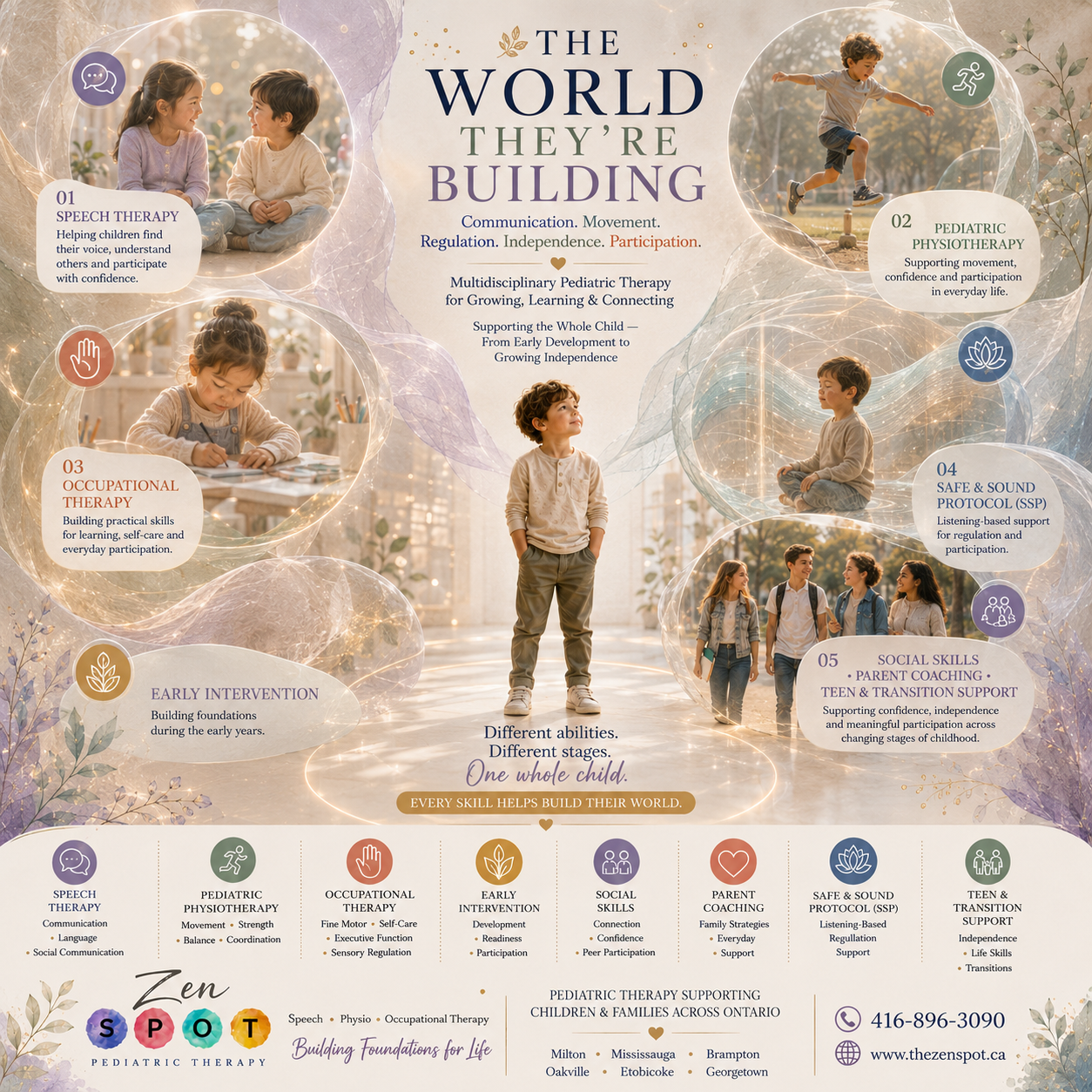
At **Zen S.P.O.T Pediatric Therapy**, our Pediatric Speech-Language Pathology services are designed to help children and young adults develop the communication skills they need to express themselves, connect with others, and participate confidently in everyday life. Serving families across **Milton, Mississauga, Brampton, Oakville, Etobicoke & Georgetown**, our Speech-Language Pathologists provide evidence-based, play-based, and functional Speech Therapy tailored to each child’s unique strengths, developmental needs, and goals. At Zen S.P.O.T, we believe communication is more than words. It includes understanding language, social interaction, body language, emotional connection, attention, and functional communication skills used across home, school, and community settings. Our Pediatric Speech Therapy services support: ✔ Speech & language delays ✔ Social communication skills ✔ Childhood Apraxia of Speech ✔ Stuttering & fluency disorders ✔ AAC communication systems ✔ Feeding & oral motor challenges ✔ Autism spectrum disorder ✔ Auditory processing difficulties ✔ Attention, sequencing & problem-solving skills Our therapy sessions integrate movement, sensory regulation, and engaging child-led interactions because communication develops best when children feel regulated, supported, and connected.
Pediatric Physiotherapy That Looks Beyond Milestones
At **Zen S.P.O.T Pediatric Therapy**, Pediatric Physiotherapy is about more than exercises, stretches, or isolated movement goals — it’s about understanding the *whole child* and helping them succeed confidently in everyday life. Serving families across **Milton, Mississauga, Brampton, Oakville, Etobicoke & Georgetown**, our multidisciplinary pediatric therapy team provides evidence-based **Pediatric Physiotherapy, Occupational Therapy, and Speech Therapy** focused on real-life function, independence, and long-term developmental success. We don’t believe in treating one symptom, one joint, or one movement pattern in isolation. Every body system and every function is connected. At Zen S.P.O.T, we use a systematic full-body approach to identify the root causes behind a child’s movement, coordination, sensory, and functional challenges while creating meaningful interventions that support success across home, school, and community environments. Our Pediatric Physiotherapy programs support: ✔ Gross motor development ✔ Fine motor coordination ✔ Posture & breath control ✔ Sensory regulation ✔ Motor planning & executive functioning ✔ Strength & endurance ✔ Toileting & pelvic floor support ✔ Activities of Daily Living (ADLs) ✔ School readiness & independence skills