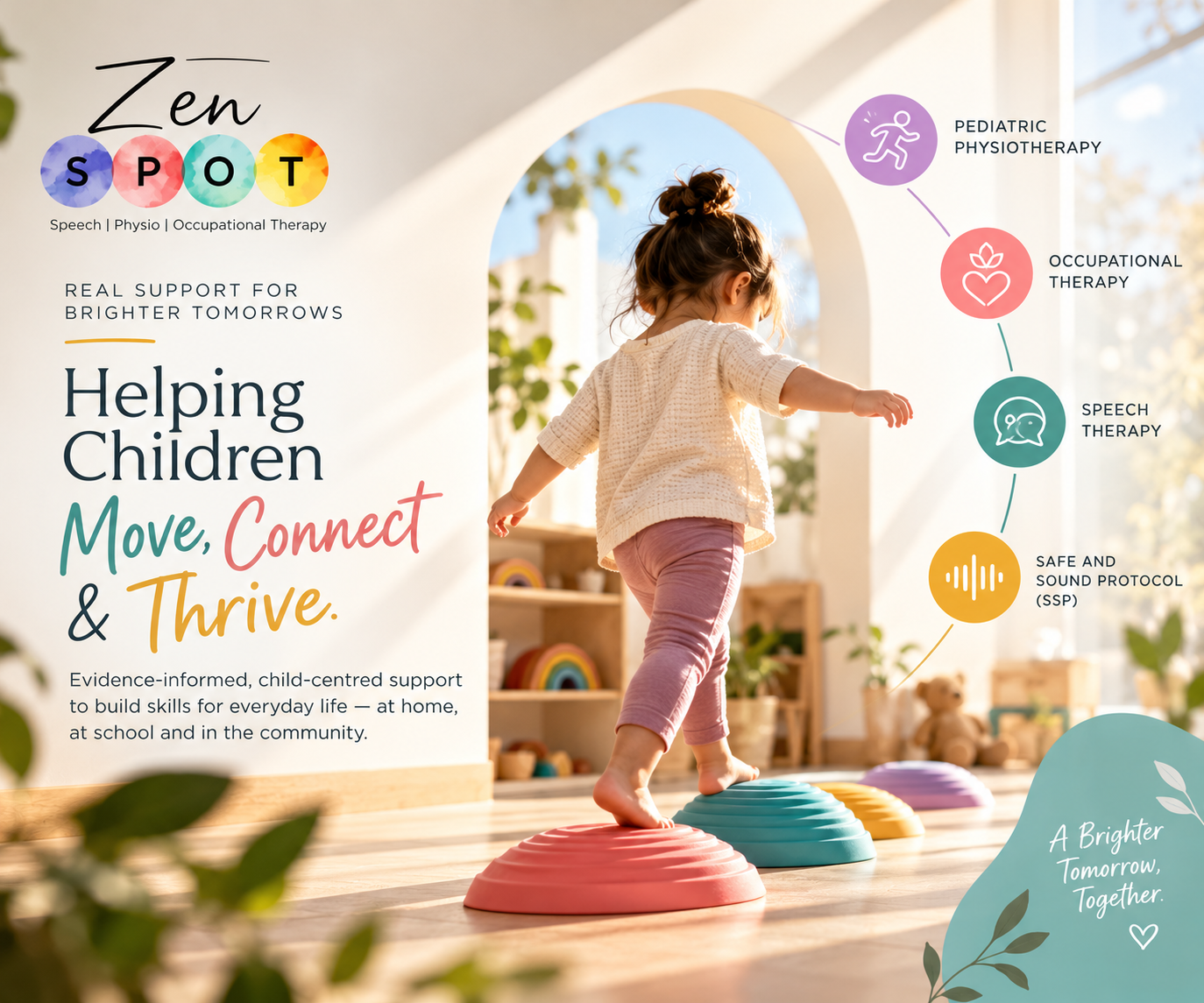
Pediatric Therapy in Milton | Zen S.P.O.T. – Helping Children Move, Connect & Thrive: How Pediatric Therapy Supports Everyday Life Helping Children Move, Connect & Thrive: How Pediatric Therapy Supports Everyday Life Childhood is made up of thousands of small but meaningful experiences. A child learns to move through a playground, communicate a need, manage a morning routine, participate in classroom activities and connect with family and friends. Each experience draws on a different combination of developmental skills. For families exploring pediatric therapy in Milton, understanding these everyday connections can help clarify what meaningful developmental support looks like. At Zen S.P.O.T. Pediatric Therapy, the philosophy behind “Helping Children Move, Connect & Thrive” centres on practical skills, individual needs and participation in everyday life. Through Pediatric Physiotherapy, Occupational Therapy, Speech Therapy and the Safe and Sound Protocol (SSP), when appropriate, the focus is on understanding each child’s needs and identifying suitable opportunities for support. The aim is not to compare children or impose a single developmental timeline. It is to recognise individual strengths, understand challenges and help children participate as meaningfully as possible at home, at school and in the community. What Does Pediatric Therapy Mean for Everyday Life? Pediatric therapy supports children’s development and functional participation through individualised assessment and appropriate therapeutic strategies. Parents may initially notice a specific concern. A child might find certain movements difficult, struggle with aspects of a daily routine, have difficulty communicating needs or experience challenges participating in particular environments. However, everyday activities rarely depend on just one skill. Getting ready for school, for example, may involve movement, balance, fine motor coordination, understanding instructions, organisation and communication. Joining a playground activity may involve physical access, confidence, social interaction and the ability to communicate with peers. Looking at the broader picture helps families understand how different skills interact. At Zen S.P.O.T., this whole-child perspective informs the way developmental and functional needs are considered. Support should be individualised according to the child, their environment and the goals that matter to the family. Pediatric Physiotherapy: Supporting Movement and Participation Movement gives children opportunities to explore their surroundings, engage in play and participate in daily activities. Pediatric Physiotherapy may address areas such as gross motor development, balance, strength, coordination, postural control and functional mobility, depending on the child’s individual needs. Consider a child who wants to join friends on the playground but finds climbing, stepping over obstacles or maintaining balance challenging. The relevant goal extends beyond completing an exercise in a clinic. It includes understanding the movement skills that may help the child participate in the activity. Similarly, moving between floor positions, navigating stairs, getting up from a chair and exploring different surfaces can involve several movement skills working together. A functional approach considers how those skills relate to the child’s everyday goals. For parents seeking pediatric physiotherapy in Milton, an individualised assessment can help clarify which movement abilities may benefit from attention and what strategies are appropriate for the child. Occupational Therapy: Building Everyday Independence Independence develops through everyday opportunities to practise meaningful activities. Putting on a jacket, managing belongings, using classroom materials, participating in play and following a familiar routine may all require a combination of fine motor, sensory, motor planning and organisational skills. Pediatric Occupational Therapy can support children with functional activities that are important to their daily lives. For example, a child who finds dressing difficult may benefit from exploring the specific demands of the task. These might include coordinating both hands, managing fasteners, maintaining balance while dressing or understanding the sequence of steps. The environment can matter, too. A lower hook, an accessible storage basket, fewer distractions or a visual routine may make an activity easier to understand and approach. The aim is not simply to ask a child to try harder. It is to identify useful strategies and opportunities for participation while respecting the child’s abilities and developmental needs. Families looking for pediatric occupational therapy in Milton may find it helpful to consider which everyday activities are difficult, what support the child currently needs and which practical goals would make a meaningful difference. Speech Therapy: Helping Children Communicate and Connect Communication is central to how children express themselves, understand others, share experiences and participate in relationships. Pediatric Speech Therapy may address areas such as receptive language, expressive language, vocabulary, sentence development, following instructions, conversation and social communication, according to each child’s needs. Communication does not look the same for every child. Some children communicate primarily through speech, while others may use gestures, pictures, augmentative and alternative communication (AAC), or a combination of methods. The important question is how a child can communicate meaningfully in their everyday environments. That might involve expressing a choice at home, understanding a classroom instruction, asking for help, joining a game or sharing an experience with a family member. Speech Therapy can help families understand the child’s communication profile and identify appropriate goals that support functional communication and participation. For families searching for speech therapy for children in Milton, an individualised approach can help identify relevant communication priorities without assuming that every child needs the same intervention. Safe and Sound Protocol: An Individualised Listening-Based Approach The Safe and Sound Protocol (SSP) is a listening-based intervention that uses specially filtered music. It may be considered as part of an individualised support plan when clinically appropriate. Families may have questions about how listening-based approaches fit alongside other forms of support. Suitability, pacing and integration should be discussed with a qualified provider who understands the individual’s needs and circumstances. SSP should not be presented as a universal solution or a replacement for other appropriate healthcare and developmental supports. Its relevance depends on the individual and the professional guidance provided. At Zen S.P.O.T., SSP is one of the approaches families can ask about when exploring the clinic’s broader range of support options. The goal is to make informed, individualised decisions rather than assume one intervention is suitable for everyone. Why Everyday Participation Matters Developmental progress becomes meaningful when children can use their