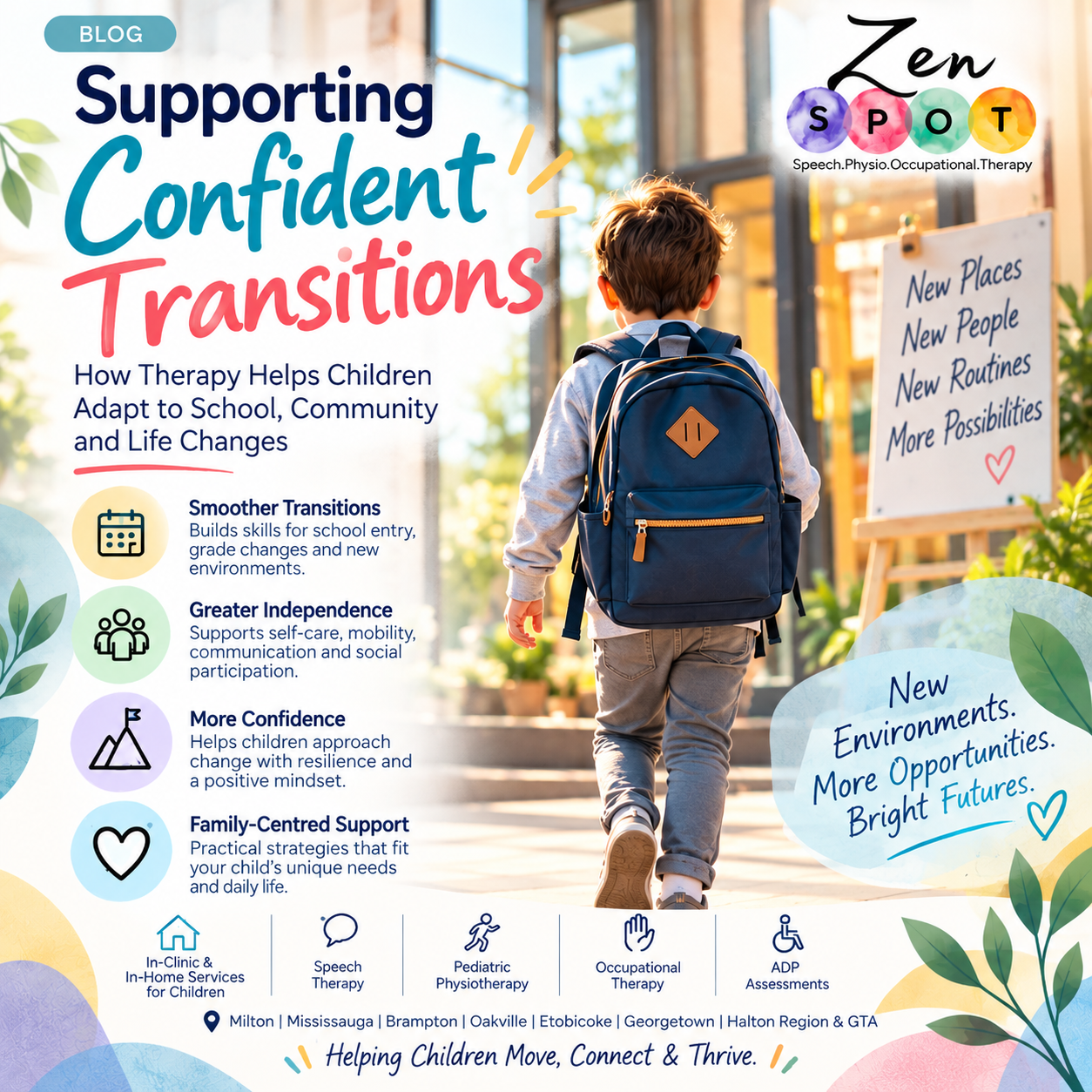
Supporting Children Through Transitions | Zen S.P.O.T. : How Therapy Helps Children Adapt to School, Community and Life Changes. Learn how pediatric therapy can help children manage school, community and daily-life transitions while building communication, mobility and independence. Supporting Confident Transitions: How Therapy Helps Children Adapt to School, Community and Life Changes Children experience transitions every day. Getting dressed in the morning. Leaving home for school. Moving from one classroom activity to another. Joining a new group. Starting kindergarten. Changing schools. Visiting a new community space. Moving from one developmental stage to another. For some children, these changes happen naturally. For others, a transition can feel much bigger than simply moving from one activity to the next. A new environment may introduce unfamiliar routines, people, expectations, communication demands or physical challenges. When several changes happen at once, children may need additional support to understand what is happening and participate successfully. Supporting children through transitions is therefore an important part of pediatric therapy. At Zen S.P.O.T. Pediatric Therapy, our multidisciplinary approach considers the functional skills children need to participate across home, school and community environments. Why Can Transitions Be Difficult for Children? A transition requires a child to shift from one situation to another. That shift can involve several skills at the same time. A child may need to stop what they are doing, understand what comes next, move to a different location, communicate with another person, manage their belongings and adapt to a new expectation. For some children, this combination can be challenging. Difficulty with transitions can sometimes appear as: These behaviours should be considered within the child’s broader developmental and functional context. Rather than asking only, “Why won’t my child transition?”, it can be more useful to ask, “What skills does my child need to make this transition easier?” Transitions Are More Than School Readiness School readiness is often associated with academic skills. However, successful participation at school involves much more. Children may need to: These are functional skills. They develop over time and can be supported through individualized pediatric therapy when appropriate. Occupational Therapy and Everyday Transitions Pediatric occupational therapy can play an important role in helping children develop functional independence. Occupational therapists may work on skills related to self-care, fine motor development, motor planning, organization, classroom participation and daily routines. For example, a child preparing for school may need support with managing a backpack, opening containers, organizing materials, dressing, toileting or participating in tabletop activities. These skills may appear small individually. Together, however, they can influence how independently a child participates in a school day. Occupational therapy can therefore focus on practical skills that have meaning beyond the therapy environment. Physiotherapy and Physical Transitions Transitions are also physical. A child may need to move from sitting to standing, navigate stairs, walk across different surfaces, get on and off playground equipment or move safely through a busy school environment. For children with developmental or physical challenges, pediatric physiotherapy can address movement skills that contribute to functional participation. This may include strength, balance, coordination, postural control, mobility and motor skills. Improving physical capability does not simply mean performing an exercise successfully. The broader goal is to help children use their developing movement skills in activities that matter to them. That could mean joining classmates on the playground, moving between classrooms or participating more independently in community activities. Communication Is Part of a Successful Transition A child cannot always communicate that a transition is difficult. They may not yet have the language to say: “I don’t understand what happens next.” “This environment is unfamiliar.” “I need more time.” “I need help.” “I am finished.” Pediatric speech therapy can support the communication skills children need to express needs, understand language, follow directions and participate socially. Functional communication can become especially important when children encounter unfamiliar people, routines or environments. Supporting communication therefore becomes part of supporting participation. Building Independence One Transition at a Time Independence rarely appears all at once. Instead, it develops through repeated opportunities to participate. A child may initially need significant adult assistance to complete a routine. Over time, the goal may be to reduce that assistance as the child develops the skills and confidence to complete more of the task independently. For example, a morning routine might gradually move from: Adult completes the task → adult guides the child → child completes part of the task → child completes the routine with minimal support. The appropriate level of assistance depends on the individual child. The important principle is to create meaningful opportunities for participation while respecting developmental needs. Preparing Children for New Environments Preparation can make an unfamiliar transition more predictable. Depending on the child’s needs, families and professionals may use strategies such as: These strategies should be individualized rather than treated as universal solutions. What supports one child may not be appropriate for another. From Home to School to Community Children do not experience development in one environment. A skill developed during therapy needs opportunities to become useful at home, school and in the community. That is why functional goals matter. A child who develops stronger communication skills may be able to participate more effectively in classroom activities. A child developing greater physical independence may find it easier to navigate school or community environments. A child developing self-care skills may become more independent during daily routines. The connection between therapy and real-life participation is what makes these skills meaningful. Family-Centred Pediatric Therapy Parents and caregivers are essential partners in understanding how a child manages transitions. They know the child’s routines, strengths, preferences and challenges across different settings. At Zen S.P.O.T. Pediatric Therapy, individualized care can bring together Speech Therapy, Pediatric Physiotherapy and Occupational Therapy according to a child’s needs and goals. This multidisciplinary perspective can help families look beyond a single skill and consider how communication, movement, self-care and participation interact in everyday life. Supporting Change Across Ontario Children and families across Ontario encounter many different transitions throughout childhood. From starting daycare or school to
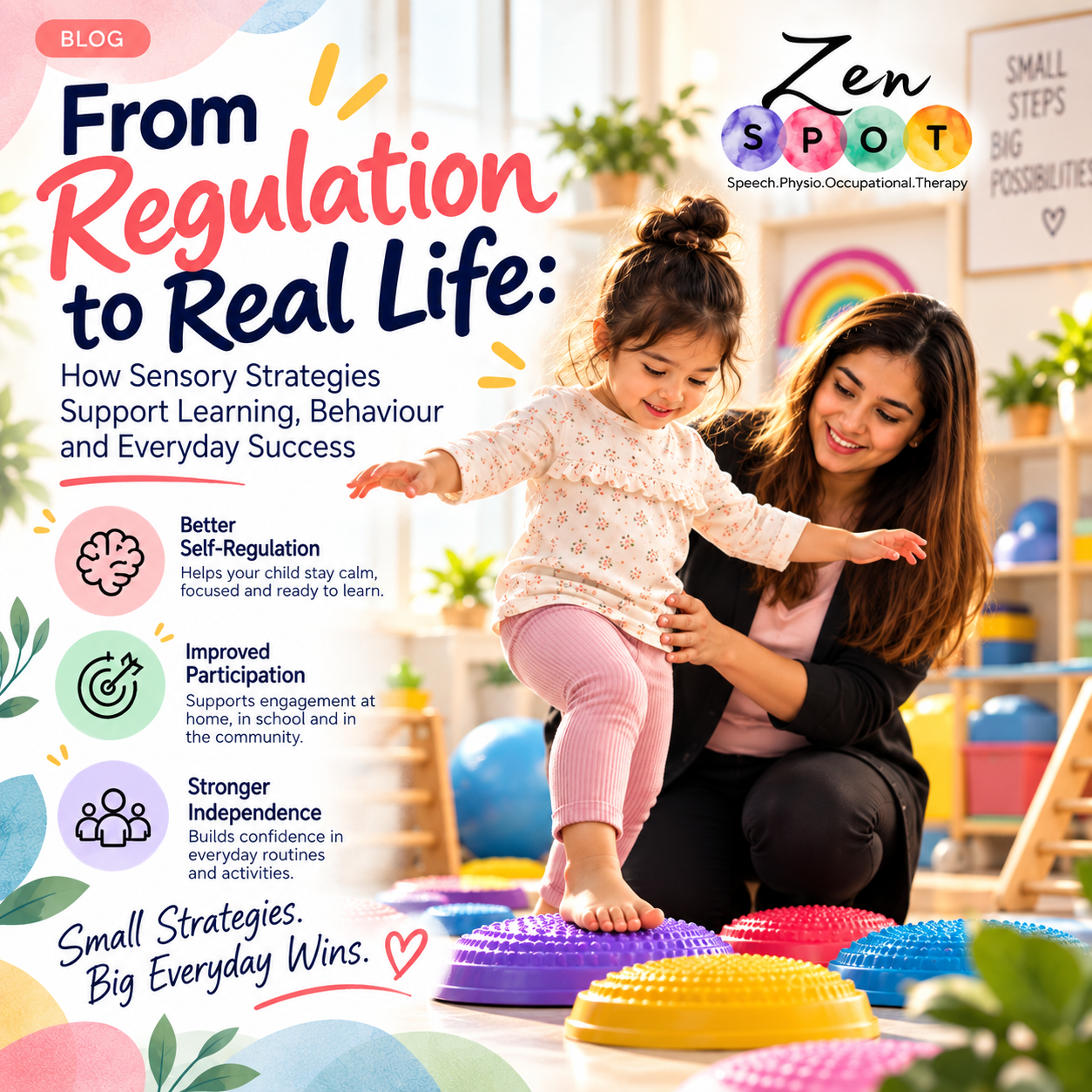
Pediatric Sensory Strategies for Regulation & Learning | Zen S.P.O.T : How Sensory Strategies Support Learning, Behaviour and Everyday Success.
Pediatric Sensory Strategies for Regulation & Learning | Zen S.P.O.T. : How Sensory Strategies Support Learning, Behaviour and Everyday Success. Discover how pediatric sensory strategies can support self-regulation, participation, learning and everyday independence for children in Ontario. A child’s ability to participate in everyday life is influenced by much more than what they can physically do or say. Being able to listen, focus, transition between activities, tolerate everyday sensations, communicate needs and remain engaged can all depend on how a child experiences and responds to the world around them. For some children, everyday environments can feel overwhelming. Sounds may seem too loud. Clothing may feel uncomfortable. Busy spaces may make it difficult to concentrate. Movement may be constantly sought out, or certain activities may be avoided altogether. This is where thoughtful pediatric sensory strategies can become an important part of individualized therapy. At Zen S.P.O.T. Pediatric Therapy, sensory support is considered in the context of the child’s individual needs, routines, strengths and participation goals. The objective is not simply to provide sensory activities. It is to help children develop practical strategies that can support participation in real-life situations. What Is Sensory Processing? Sensory processing describes how the nervous system receives, organizes and responds to information from the environment and the body. Children receive sensory information through systems associated with sight, hearing, touch, taste and smell, as well as systems that provide information about movement and body position. The way a child responds to this information can influence everyday participation. For example, one child may seek frequent movement and find it difficult to remain seated, while another may become uncomfortable in a busy environment. A child may also have difficulty noticing body position, coordinating movements or adapting when sensory demands change. These differences do not automatically indicate a problem. Every child processes sensory information differently. However, when sensory responses consistently interfere with daily activities, individualized support may be beneficial. When Sensory Needs Affect Everyday Participation Sensory processing differences can sometimes become noticeable through everyday routines rather than through one specific behaviour. Parents may notice that a child: These observations are important because they provide context about where participation becomes difficult. Rather than focusing only on the behaviour itself, pediatric therapy can explore what may be contributing to the difficulty and what practical strategies could make participation more manageable. Sensory Strategies Should Have a Purpose Sensory strategies are most useful when they are connected to a functional goal. For example, the goal may be helping a child participate in classroom activities, tolerate a grooming routine, remain engaged during tabletop tasks or transition between activities with greater predictability. A strategy should therefore answer an important question: What does this child need to participate more successfully in this specific situation? Depending on the child and their individualized assessment, an occupational therapist may consider environmental modifications, movement opportunities, positioning, activity structure, visual supports or other strategies that fit naturally into the child’s routine. The emphasis is on meaningful participation rather than completing sensory activities simply for the sake of providing sensory input. Supporting Self-Regulation in Everyday Life Self-regulation involves a child’s ability to manage their responses and participate in activities across different situations. It can influence attention, transitions, emotional responses, social participation and engagement in everyday routines. Children develop these skills over time. They may initially depend heavily on adults to help them recognize what they need and adjust to challenging situations. With appropriate support, children can gradually develop greater awareness of their own responses and learn strategies that can help them participate. This is why regulation should be viewed as more than simply “calming down.” The bigger objective is helping a child become more available for learning, interaction, movement and participation. From the Therapy Room to Home and School One of the most important considerations in pediatric therapy is whether strategies can translate into everyday life. A child may demonstrate a skill during a structured therapy session, but meaningful progress also involves using developing skills in environments where real demands occur. That could mean: This is where family-centred therapy becomes particularly valuable. Parents and caregivers understand the child’s routines, preferences and challenges in ways that cannot be replicated during a therapy appointment. Collaborative care can help connect therapeutic strategies with the situations families experience every day. The Role of Pediatric Occupational Therapy Pediatric occupational therapy can address the relationship between sensory processing, motor skills, attention, routines and functional participation. At Zen S.P.O.T., occupational therapy may support children experiencing challenges related to sensory processing, fine motor development, motor planning, coordination, self-care, classroom participation and everyday independence. Intervention is individualized because two children with similar challenges may require very different approaches. A therapist may look at the child’s abilities, environment, routines and functional goals before developing strategies that are appropriate for their needs. The goal is not to change who a child is. It is to help create conditions in which the child can participate, communicate, learn and engage more successfully. Why Functional Participation Matters The ultimate measure of a strategy is not how impressive it looks during therapy. It is whether it helps a child participate in something meaningful. That could be sitting at the family table, joining a classroom activity, playing with peers, getting dressed, completing a school task or navigating a community environment. Small changes can have practical significance. When a child can participate more comfortably, families may discover new opportunities for independence. When transitions become more predictable, everyday routines may feel easier to manage. When a child develops strategies for responding to sensory demands, participation can become more accessible. These are the connections between regulation and real life. A Collaborative Approach for Children and Families Every child brings a different combination of strengths, preferences, developmental skills and support needs. At Zen S.P.O.T. Pediatric Therapy, our multidisciplinary services include Speech Therapy, Pediatric Physiotherapy and Occupational Therapy. This allows care to remain focused on the whole child and the functional activities that matter to families. For children who experience sensory processing or regulation