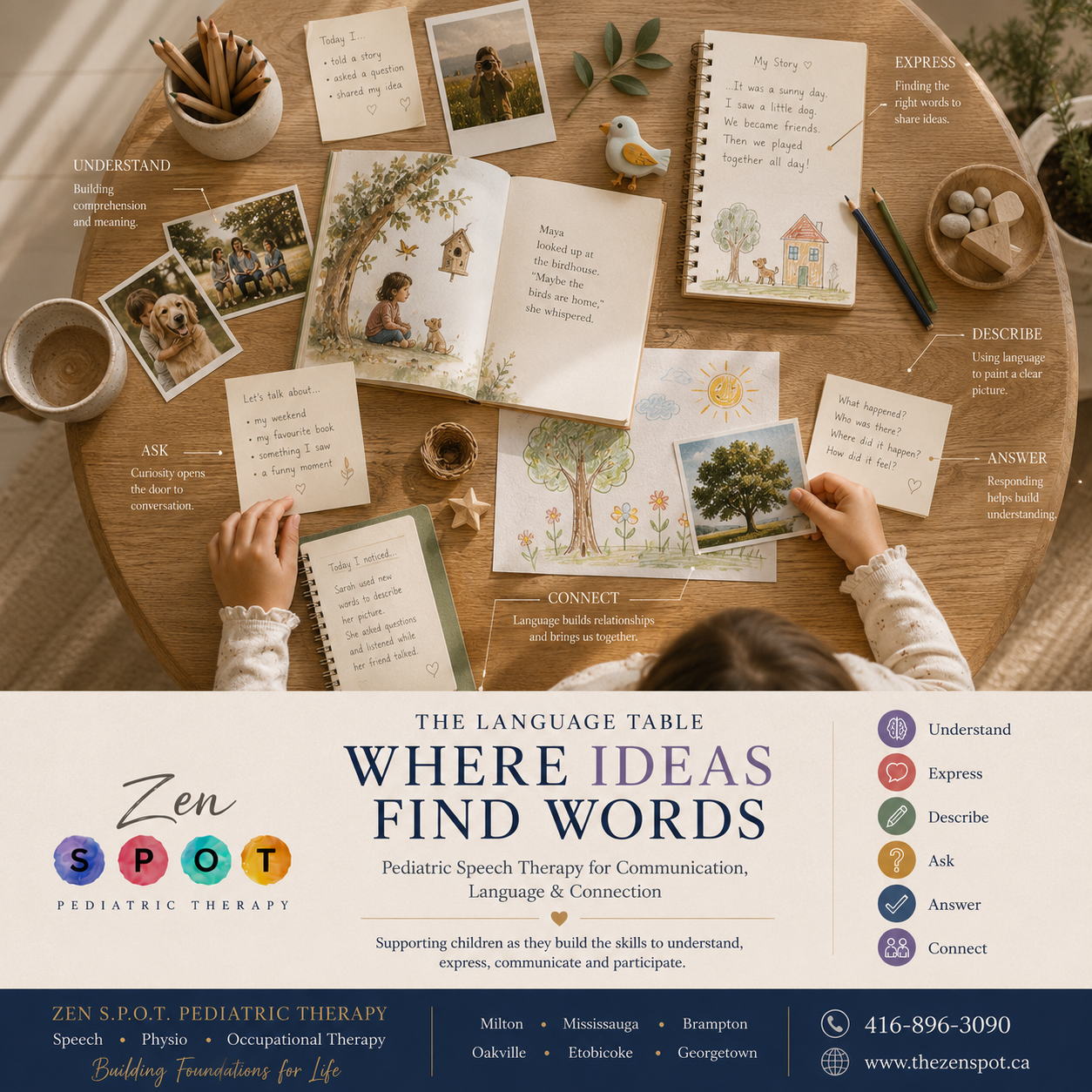
Speech Therapy Milton | Pediatric Communication | Zen S.P.O.T. : Looking for Speech Therapy in Milton? Zen S.P.O.T. supports children’s language, communication, comprehension and social participation across Ontario. Speech Therapy in Milton: Helping Children Find Their Words Communication is one of the foundations of childhood. It helps children tell someone what they need, understand what others are saying, ask questions, share experiences, participate at school, build friendships and express their ideas. But communication is much more than producing words. For some children, communication may involve challenges with understanding language, finding the right words, building sentences, telling stories, following conversations or participating socially. For families looking for Speech Therapy in Milton, the most important question is often not simply, “Can my child talk?” It is: “How can my child communicate more meaningfully in everyday life?” At Zen S.P.O.T. Pediatric Therapy, Speech Therapy is approached within the broader context of child development, communication and participation. What Does Pediatric Speech Therapy Support? Pediatric Speech Therapy can address a wide range of communication and language needs. Depending on the individual child, support may involve: Every child has a different communication profile. Some children may understand considerably more than they can express. Others may communicate readily in familiar environments but experience greater difficulty participating in group conversations, classrooms or unfamiliar situations. That is why individualized assessment and goal-setting are important components of pediatric Speech Therapy. Speech Therapy Is About More Than Speech The term Speech Therapy can sometimes make people think only about pronunciation or speech sounds. Communication is broader than that. A child may pronounce words clearly but still find it difficult to: Conversely, a child may have strong ideas and understanding but need support accessing or expressing those ideas through spoken language. Pediatric Speech Therapy can therefore encompass speech, language, comprehension, expression and social communication. Language Development and Everyday Communication Language is constantly being used throughout childhood. Consider an ordinary day. A child wakes up and tells a parent what they dreamed about. At school, they listen to instructions. They ask a question. They explain something to a teacher. At lunch, they talk with classmates. After school, they tell their family what happened. During play, they negotiate rules with friends. At home, they explain what they want for dinner. These are not isolated therapy exercises. They are real communication opportunities. This is why a strong pediatric Speech Therapy program should consider how communication skills transfer into the environments where children actually live, learn, play and connect. Supporting Comprehension Communication begins with understanding. Children may experience difficulty understanding: Comprehension difficulties can affect classroom participation and everyday interactions. Speech Therapy may therefore incorporate strategies and activities designed around a child’s individual language profile and functional goals. The objective is not simply to answer a question correctly in a therapy setting. It is to help the child understand and use language meaningfully in everyday contexts. Supporting Expressive Language Some children know what they want to communicate but have difficulty putting their thoughts into words. Expressive language may involve: Vocabulary Finding the words needed to describe something. Sentence Formation Combining words into increasingly meaningful sentences. Narrative Skills Explaining what happened and organizing events into a coherent story. Question Asking Learning to seek information and clarify understanding. Idea Expression Sharing opinions, experiences and ideas with others. These skills can become increasingly important as children progress through school and social environments. Social Communication and Connection Communication also happens between people. Children learn to participate in conversations by navigating skills such as: Social communication can influence how children participate with peers, teachers, siblings and family members. At Zen S.P.O.T., the emphasis remains on helping children develop meaningful communication opportunities rather than forcing every child into a single model of social interaction. Speech Therapy and School Participation School requires children to communicate in many different ways. They may need to: For this reason, Pediatric Speech Therapy may be relevant to school readiness and classroom participation when communication skills are affecting a child’s ability to engage. The aim is to connect therapeutic goals with the child’s actual educational and social environments. Speech Therapy in Milton and Surrounding Ontario Communities Families searching for Speech Therapy in Milton may also be considering services in surrounding communities. Zen S.P.O.T. serves children and families across: Milton Mississauga Brampton Oakville Etobicoke Georgetown This geographic focus allows Zen S.P.O.T. to build a stronger local presence around Pediatric Therapy in Ontario, while maintaining a consistent focus on individualized developmental support. For families searching specifically for Speech Therapy in Mississauga, Speech Therapy in Oakville, Speech Therapy in Brampton, Speech Therapy in Etobicoke or Speech Therapy in Georgetown, the underlying question remains the same: What kind of communication support does this individual child need to participate more meaningfully in everyday life? When Should Parents Consider Speech Therapy? There is no single communication profile that determines whether a child may benefit from Speech Therapy. Families may consider seeking professional guidance when they have ongoing concerns about areas such as: A professional assessment can help clarify a child’s strengths, needs and appropriate goals. Importantly, seeking information does not mean assuming that something is “wrong” with a child. It can simply be a way of understanding their communication profile and identifying appropriate support. Why Individualized Pediatric Speech Therapy Matters Children do not all learn communication in the same way. One child may need support with vocabulary. Another may need help organizing stories. Another may understand language well but struggle to participate in conversations. Another may communicate differently across home, school and community settings. An individualized approach allows therapeutic goals to reflect: the child’s current skills their communication priorities their family environment their school context their participation goals and their developmental stage. At Zen S.P.O.T., Speech Therapy forms part of a broader multidisciplinary Pediatric Therapy model alongside Occupational Therapy and Physiotherapy. Communication Is a Foundation for Participation The ultimate value of communication is not measured only by how many words a child can say. It is reflected in what those communication skills allow them