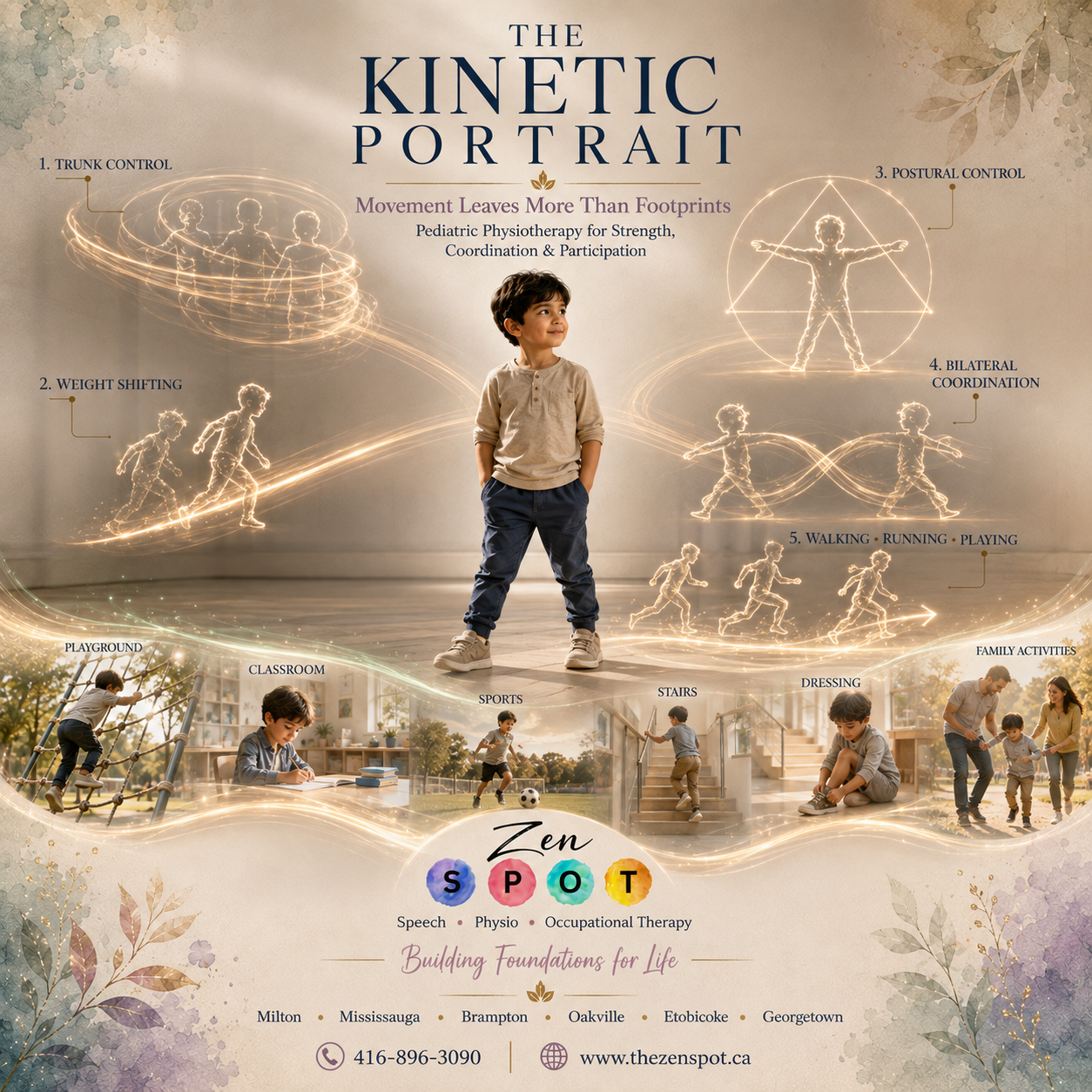
Pediatric Physiotherapy: Movement, Mobility & Participation | Zen S.P.O.T : Discover how Pediatric Physiotherapy supports balance, coordination, postural control, gross motor development and functional mobility for children at Zen S.P.O.T. Ontario. MOVEMENT LEAVES MORE THAN FOOTPRINTS How Pediatric Physiotherapy Supports Movement, Participation and Functional Mobility Every movement gives children opportunities to explore, learn and participate. A child climbing playground equipment, navigating stairs, joining a sports activity, sitting during a classroom task or moving through a daily routine is using much more than physical strength. These everyday activities require an interaction between balance, postural control, coordination, strength, motor planning and functional mobility. Movement development is therefore about more than reaching individual milestones. It is about what children can do with the skills they develop. At Zen S.P.O.T. Pediatric Therapy, our Pediatric Physiotherapists provide individualized support for children’s movement and functional mobility. Our collaborative model also allows Physiotherapy, Occupational Therapy and Speech Therapy to work together when a child’s developmental needs cross multiple areas. What Does Pediatric Physiotherapy Support? Pediatric Physiotherapy focuses on children’s movement, physical function and participation. Every child develops differently, and physiotherapy support is individualized according to the child’s abilities, needs and functional goals. Depending on the child, therapy may address areas such as: These skills can influence how children interact with their surroundings. For example, navigating a playground requires balance and coordination. Managing stairs requires strength, postural control and movement planning. Participating in sports involves multiple movement systems working together. Movement skills are therefore connected to everyday participation. Movement Is More Than Milestones Developmental milestones can provide useful information about a child’s development, but they do not tell the entire story. A child may achieve a particular movement milestone while still experiencing challenges with functional movement. For example, a child may be able to walk but have difficulty: This is why a functional perspective is important. The question is not simply: “Can the child perform the movement?” It can also be: “How does the child use that movement in everyday life?” Balance and Postural Control Balance allows children to maintain and adjust their body position while interacting with their environment. Postural control provides the foundation for maintaining appropriate body alignment during movement and activity. Children use these abilities constantly. Consider: When balance and postural control are challenged, everyday activities can require greater effort. Pediatric Physiotherapy may incorporate individualized activities designed to support movement control, balance and functional participation. Coordination and Motor Planning Movement is rarely one-dimensional. A child kicking a ball, climbing playground equipment or learning a new sport must coordinate multiple body movements. Motor planning involves organizing and carrying out movements for a purposeful activity. Children may encounter challenges when learning unfamiliar movement sequences or coordinating different parts of their body. Pediatric Physiotherapy can incorporate purposeful activities that allow children to practise movement patterns in ways that relate to their interests and everyday environments. This can include activities involving: The goal is to connect movement practice with meaningful participation. Strength Supports Functional Movement Strength is another component of functional mobility. Children use strength when they: Pediatric Physiotherapy may incorporate strengthening activities that are appropriate for the child’s developmental level and functional goals. Rather than treating strength as an isolated target, therapists can connect strengthening activities to meaningful movement and participation. This helps keep therapy purposeful. Gross Motor Development and Everyday Participation Gross motor development involves larger body movements and the coordination required for activities such as walking, running, jumping, climbing and maintaining body positions. These abilities create opportunities for children to explore their environment. A child who develops greater confidence with movement may have more opportunities to participate in: Playground activities Climbing, running, balancing and interacting with peers. School activities Moving around the classroom, participating in physical education and managing transitions. Sports Running, changing direction, balancing and coordinating movement. Community activities Walking, navigating different surfaces and participating in family activities. Daily routines Moving between positions and managing everyday physical demands. This is why movement matters beyond the therapy session. Functional Mobility: Connecting Skills to Real Life Functional mobility refers to how children move through the environments and activities that make up everyday life. This may involve: A Pediatric Physiotherapy program can be designed around the child’s actual functional needs. The focus can therefore move beyond isolated exercises toward purposeful movement and participation. A Collaborative Approach to Pediatric Therapy Children do not always experience developmental challenges within a single area. Movement may intersect with communication, sensory processing, fine-motor skills, self-care, attention and participation. That is why Zen S.P.O.T. uses a collaborative model involving: Pediatric Physiotherapy Supporting movement, gross motor development, balance, postural control, coordination, strength and functional mobility. Pediatric Occupational Therapy Supporting fine-motor skills, sensory processing, self-regulation, daily living activities, school participation and functional independence. Pediatric Speech Therapy Supporting communication, language, social communication and participation. When developmental needs cross multiple areas, collaboration between disciplines can help create a more connected therapeutic approach. The objective remains the same: Help the child participate more fully in everyday life. Movement at Home, School and in the Community Movement development does not happen only during therapy. Children learn through everyday experiences. A playground can become an opportunity to practise balance. A staircase can become an opportunity to practise controlled movement. A family walk can provide opportunities for endurance and mobility. A game with a ball can encourage coordination. A classroom transition can require postural control and functional mobility. These everyday environments provide meaningful contexts for movement. At Zen S.P.O.T., therapists can work with families to connect therapeutic goals with the activities and environments that matter to each child. Pediatric Physiotherapy in Milton, Mississauga, Brampton, Oakville, Etobicoke and Georgetown Zen S.P.O.T. Pediatric Therapy supports families across communities in the Greater Toronto Area, including: Milton Mississauga Brampton Oakville Etobicoke Georgetown Families seeking Pediatric Physiotherapy in Ontario can connect with Zen S.P.O.T. to discuss their child’s movement, functional mobility and developmental needs. Assessment and therapeutic recommendations are individualized according to each child’s presentation and goals. What Makes Functional Movement Meaningful? Movement becomes meaningful when
Tumble Forms Grasshopper Positioning System | Zen S.P.O.T.
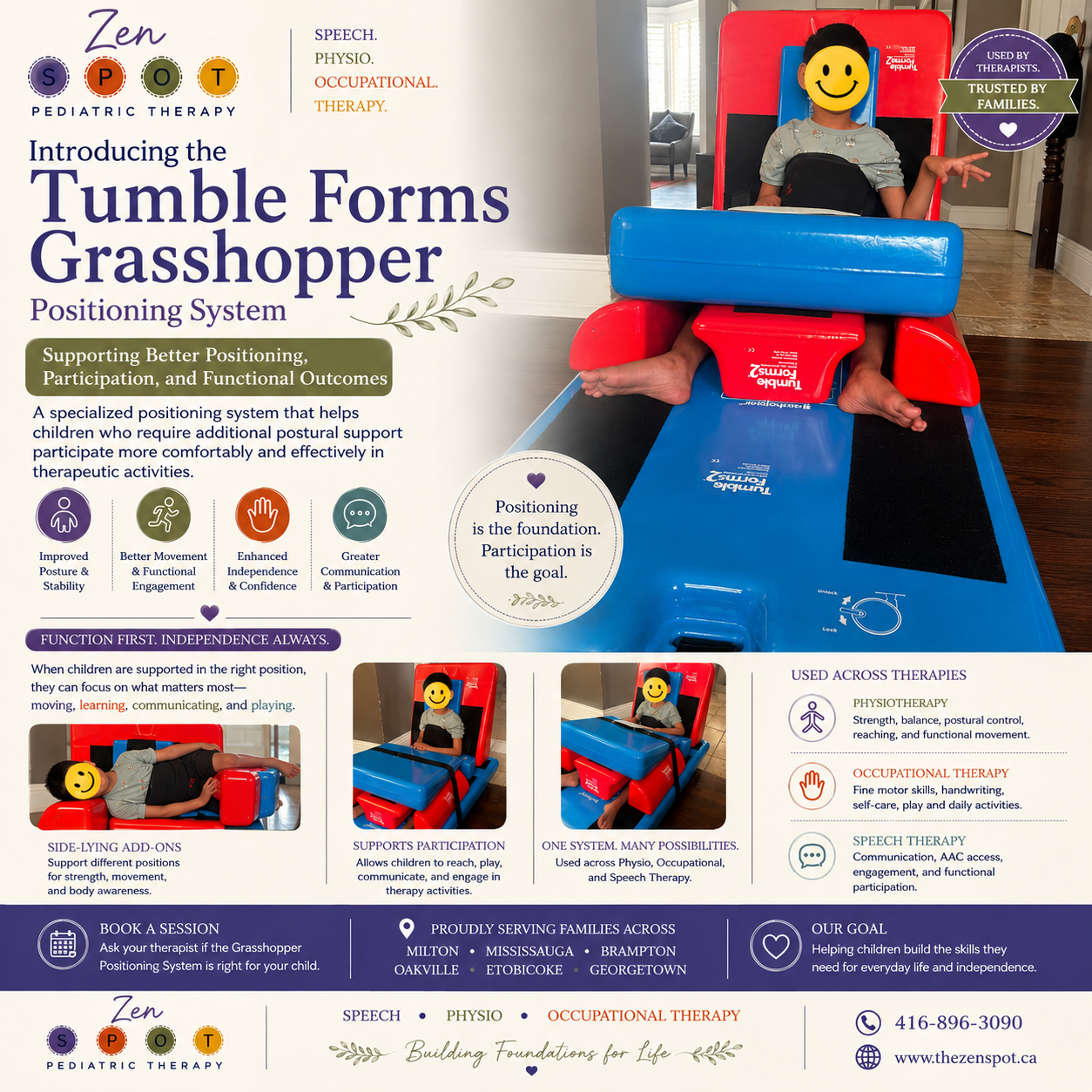
Tumble Forms Grasshopper Positioning System | Zen S.P.O.T.- Discover how Zen S.P.O.T. uses the Tumble Forms Grasshopper Positioning System to support positioning, movement and functional participation in pediatric therapy. Tumble Forms Grasshopper Positioning System at Zen S.P.O.T.: Supporting Positioning, Movement and Functional Participation Every child deserves the opportunity to participate. Sometimes, the right position creates the opportunity. At Zen S.P.O.T. Pediatric Therapy, we continually look for ways to make pediatric therapy more individualized, functional and meaningful. One of the specialized resources now available at Zen S.P.O.T. is the Tumble Forms Grasshopper Positioning System, a supportive positioning system that can be incorporated into therapy when a child requires additional postural support. For children who have difficulty maintaining an optimal position independently, positioning can influence how easily they can access movement, play, communication, fine-motor activities and other functional tasks. The purpose is not simply to help a child “sit properly.” The purpose is to create an appropriate foundation from which a child can move, play, communicate, learn and participate. At Zen S.P.O.T., this reflects an important principle: Position → Movement → Function → Participation What Is the Tumble Forms Grasshopper Positioning System? The Tumble Forms Grasshopper Positioning System is a supportive positioning resource designed to assist children who may have difficulty maintaining a functional body position independently. Depending on the child’s needs and clinical goals, positioning can provide support around areas such as the trunk, pelvis, legs and feet. This can help therapists establish a more stable and functional starting position while the child participates in purposeful therapeutic activities. Every child has different positioning requirements. For this reason, the Grasshopper is not intended to be a one-size-fits-all solution. At Zen S.P.O.T., therapists consider the child’s abilities, goals, movement patterns, tolerance and functional needs before determining whether supported positioning may be appropriate. Why Does Positioning Matter in Pediatric Therapy? Positioning is an important part of many pediatric therapy activities because children often need to manage several physical and cognitive demands at the same time. A child who is working hard simply to maintain their body position may have fewer opportunities to focus on the activity in front of them. With appropriate support, a therapist may be able to create opportunities for the child to direct more attention toward a purposeful task. Positioning may support activities involving: The objective is not passive positioning. The objective is active participation. Positioning Is Not the End Goal At Zen S.P.O.T., equipment is viewed as a therapeutic tool rather than an endpoint. The Grasshopper may provide a supportive foundation, but the child remains an active participant in the therapeutic process. This distinction is important. Rather than positioning a child and expecting the equipment to create the outcome, therapists can use supported positioning while incorporating purposeful activities that relate to the child’s individual goals. For example, a child who experiences difficulty maintaining an upright position may be supported while working on reaching, playing, communicating, completing a fine-motor task or interacting with another person. The positioning provides the foundation. The activity provides the purpose. Position → Movement → Function A central concept behind individualized positioning is the relationship between body position and functional activity. When a child’s pelvis, trunk, legs or feet require additional support, the therapist may modify the position to create a more appropriate foundation for movement. From there, the child may be able to participate in activities targeting: Postural control → reaching → hand use → play → communication → participation This does not mean that positioning automatically produces a particular therapeutic outcome. Instead, it gives the therapist another way to structure the environment around the child’s needs. That is consistent with Zen S.P.O.T.’s broader function-first approach to pediatric therapy. Grasshopper Positioning in Pediatric Physiotherapy The Tumble Forms Grasshopper Positioning System can be incorporated into Pediatric Physiotherapy when supported positioning is relevant to the child’s goals. Depending on the individual clinical plan, activities may address: Trunk and Core Strength Supported positioning can provide an appropriate starting point for activities involving trunk engagement and postural control. Weight Shifting Therapists may incorporate purposeful reaching and movement activities that encourage weight shifting within an appropriately supported position. Balance and Postural Control Positioning may help therapists work on alignment, stability and controlled movement during functional activities. Reaching and Movement Children can participate in reaching activities while working on body awareness, upper-limb use and movement control. Functional Movement The ultimate objective is to connect therapeutic movement with meaningful activities rather than isolate movement from everyday participation. For families seeking pediatric physiotherapy in Milton, Mississauga, Brampton, Oakville, Etobicoke or Georgetown, this type of individualized equipment can form part of a broader assessment-driven therapeutic approach at Zen S.P.O.T. Grasshopper Positioning in Occupational Therapy Positioning can also support Pediatric Occupational Therapy activities when appropriate. Occupational therapy focuses on helping children participate in meaningful everyday occupations and routines. With an appropriate position, therapists may incorporate activities involving: The important connection is between position and occupation. The objective is not simply improved positioning in isolation. It is helping create opportunities for a child to participate in an activity that matters to them. Positioning and Speech Therapy The relationship between positioning and communication is another important consideration. A child may require postural support while participating in structured or play-based communication activities. Depending on the child’s individual needs, supported positioning may be incorporated while working on: The specific approach is individualized and determined by the child’s therapist. At Zen S.P.O.T., Speech Therapy, Physiotherapy and Occupational Therapy can work as complementary components of a broader developmental and functional approach. Side-Lying Positioning Options Zen S.P.O.T. is also able to use side-lying positioning add-ons with the Grasshopper system when clinically appropriate. Side-lying can provide a different movement experience and may create opportunities to explore: For children who have difficulty maintaining side-lying independently, additional support can allow therapists to explore activities in a more controlled and individualized position. Again, the objective remains active and purposeful participation. Supporting Children With Individualized Positioning No two children move in exactly the same way. A positioning