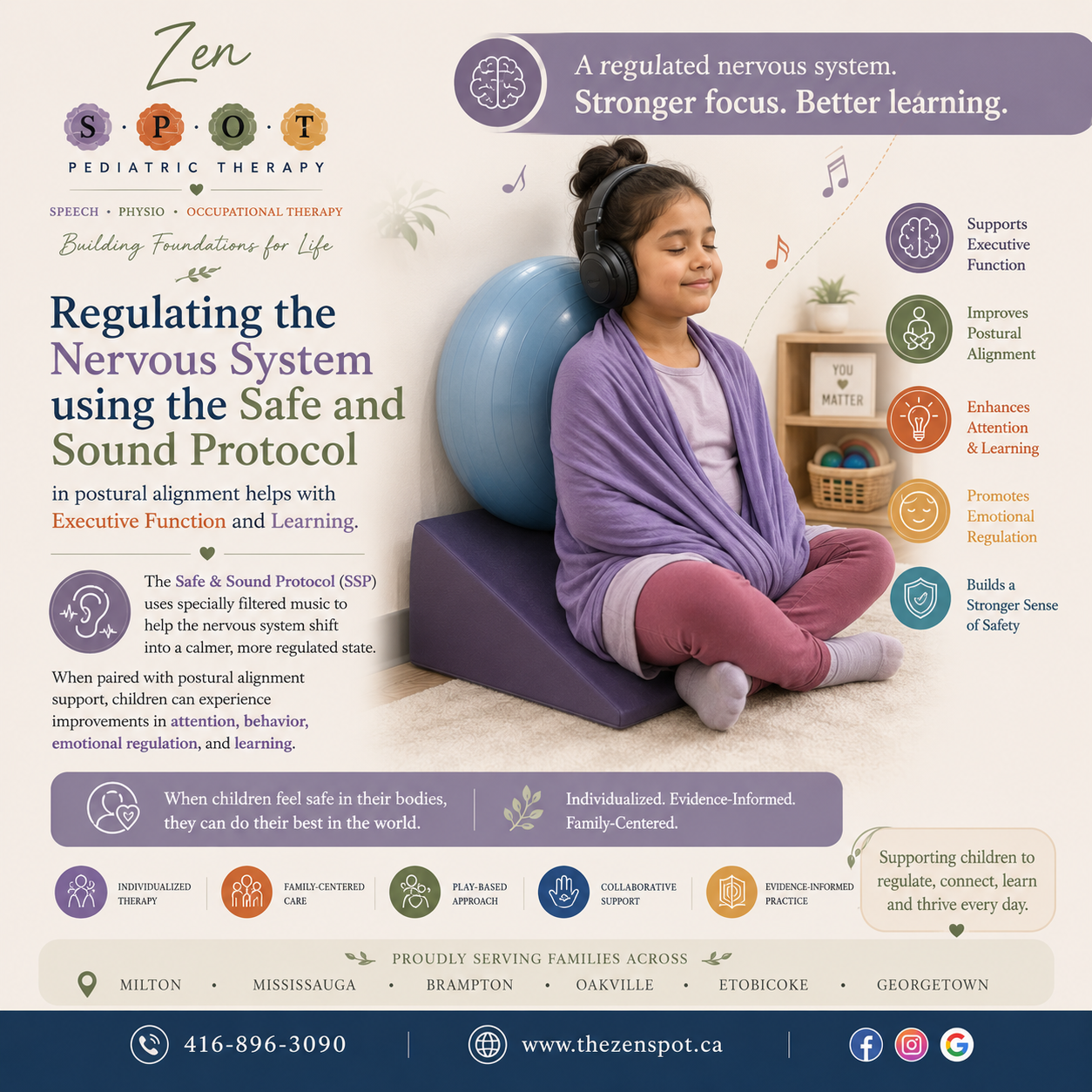
Safe & Sound Protocol | Executive Function | Zen S.P.O.T Strong Regulation Supports Better Learning: How the Safe & Sound Protocol (SSP) Helps Build Executive Function in Children Introduction Every child learns differently. While attention, planning, memory, emotional regulation, and flexible thinking are often viewed as purely cognitive skills, these abilities are closely connected to how the nervous system functions. When a child feels safe, regulated, and supported, the brain is better prepared to focus, solve problems, engage socially, and participate in everyday learning experiences. Conversely, when the nervous system is overwhelmed or constantly responding to stress, executive function skills can become more difficult to access. At Zen S.P.O.T Pediatric Therapy, we recognize that meaningful learning begins with regulation. Our individualized approach may include the Safe and Sound Protocol (SSP) alongside other therapeutic strategies, such as postural alignment and movement-based interventions, when clinically appropriate. Together, these supports help create stronger foundations for attention, participation, emotional regulation, and everyday success. What Is the Safe and Sound Protocol? The Safe and Sound Protocol (SSP) is an evidence-informed listening intervention developed from Polyvagal Theory, which explores how the autonomic nervous system influences our sense of safety, connection, and engagement. Using specially filtered music delivered through headphones, the SSP is designed to support nervous system regulation. Sessions are guided and individualized, with pacing adjusted according to each child’s unique responses and therapeutic needs. The goal is not simply to listen to music—it is to help create conditions where the nervous system can better support learning, communication, emotional regulation, and participation in daily life. Understanding Executive Function Executive function refers to a group of cognitive skills that help children manage everyday tasks and adapt to changing situations. These skills include: These abilities influence how children participate at home, in school, during play, and within their community. Why Regulation Comes Before Learning Children are not expected to perform at their best when they feel unsafe or overwhelmed. When the nervous system is dysregulated, the brain often prioritizes protection over higher-level thinking. This can affect a child’s ability to: Supporting regulation helps create an environment where executive function skills can develop more effectively. The Connection Between Postural Alignment and Learning Learning involves much more than cognitive ability alone. Postural stability provides a physical foundation that allows children to direct their attention toward learning rather than maintaining balance or managing inefficient movement patterns. Good postural control supports: Movement quality and regulation often work together to support successful participation. How the Safe and Sound Protocol Complements Therapy At Zen S.P.O.T Pediatric Therapy, every child receives an individualized treatment plan. When clinically appropriate, the Safe and Sound Protocol may be integrated alongside other interventions, including: This collaborative approach recognizes that development is interconnected. Individualized Care Matters No two children have identical developmental profiles. Some children may experience: Because every child is unique, therapy should always be tailored to their individual strengths, needs, and goals. Supporting Everyday Participation Executive function is not only about academic performance. These skills influence everyday participation, including: Our goal is to support meaningful participation across all environments. A Collaborative Approach Meaningful progress often occurs when everyone works together. Our team collaborates with: Collaboration helps ensure strategies remain consistent across home, school, and community settings. Why Families Choose Zen S.P.O.T Pediatric Therapy Families choose Zen S.P.O.T because we focus on the whole child rather than isolated symptoms. Our approach emphasizes: Every therapeutic recommendation is designed to support long-term success in real-life environments. Frequently Asked Questions Can SSP improve executive function? The Safe and Sound Protocol is designed to support nervous system regulation. Improved regulation may help create conditions that support executive function, attention, emotional regulation, and participation. Individual outcomes vary. Is SSP appropriate for every child? Not necessarily. Suitability should always be determined through an individualized assessment conducted by qualified professionals. Can SSP be combined with Occupational Therapy or Physiotherapy? Yes. When clinically appropriate, SSP may complement Occupational Therapy, Pediatric Physiotherapy, Speech-Language Therapy, and other evidence-informed interventions as part of a comprehensive treatment plan. Where is Zen S.P.O.T located? Zen S.P.O.T proudly supports families throughout: Final Thoughts Learning is built on more than academic instruction—it begins with a nervous system that feels regulated, supported, and ready to engage. By taking a whole-child approach that may include the Safe and Sound Protocol alongside individualized therapeutic interventions, Zen S.P.O.T Pediatric Therapy helps children build stronger foundations for attention, emotional regulation, participation, and lifelong learning. Every child deserves the opportunity to reach their potential through care that is compassionate, collaborative, and evidence-informed. Call to Action If you would like to learn more about the Safe and Sound Protocol (SSP) or how our multidisciplinary team supports children’s development, contact Zen S.P.O.T Pediatric Therapy. 📍 Serving Milton, Mississauga, Brampton, Oakville, Etobicoke & Georgetown 📞 416-896-3090 🌐 www.thezenspot.ca Speech • Physio • Occupational Therapy Building Foundations for Life Safe and Sound Protocol