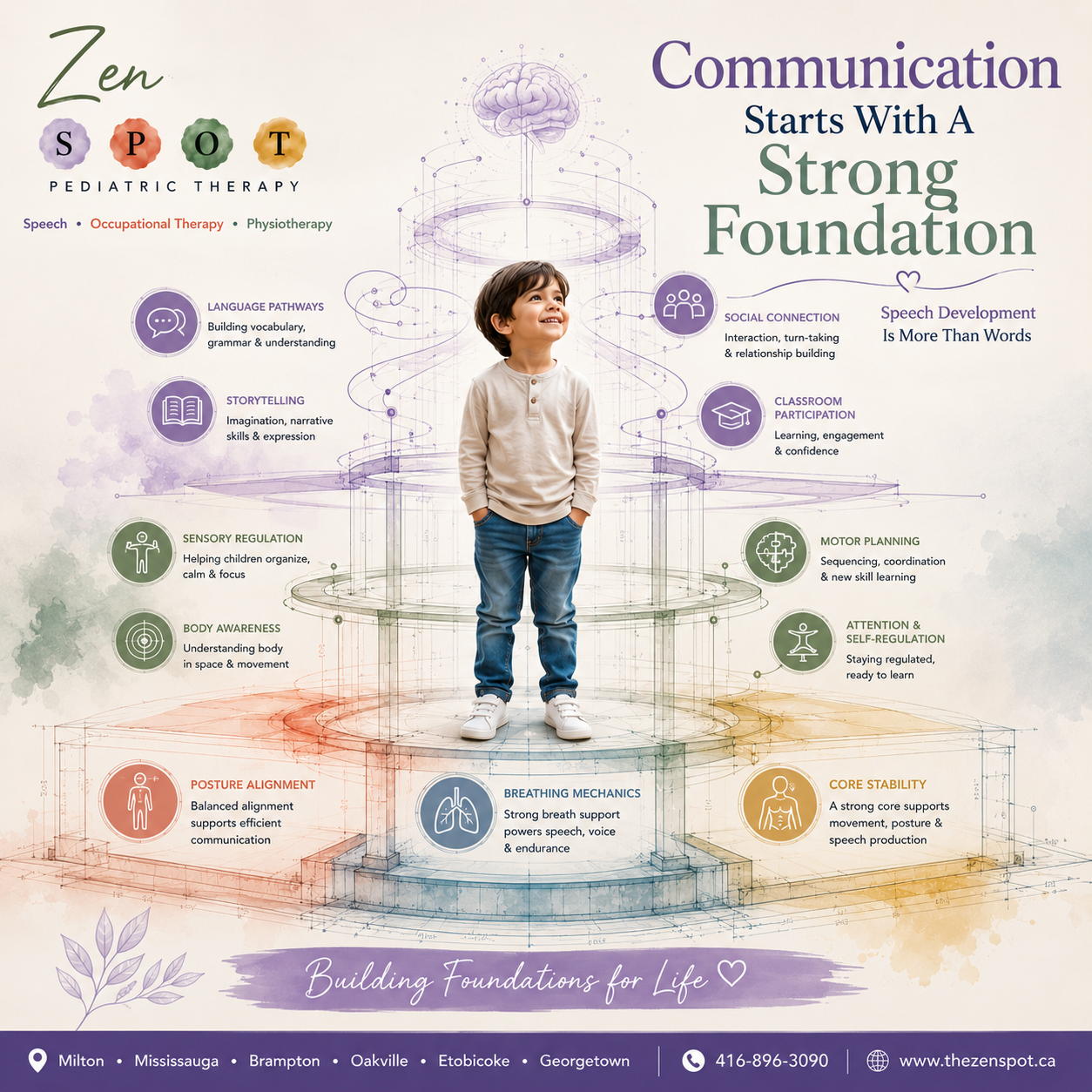
Why Posture Matters for Speech Development: The Missing Piece Many Parents Overlook Why Posture Matters for Speech Development | Zen S.P.O.T Pediatric Therapy When parents think about speech development, they often focus on words, sounds, vocabulary, and language milestones. Few realize that one of the most important foundations for communication begins long before a child says their first sentence. It begins with the body. At Zen S.P.O.T Pediatric Therapy, we believe communication is not an isolated skill. Speech develops alongside movement, sensory processing, body awareness, motor planning, regulation, and physical development. This whole-child perspective helps us understand why some children may struggle with communication even when the challenge does not appear to be directly related to speech. A growing body of research continues to explore how physical development and communication are interconnected. While posture does not cause speech delays, the systems that support posture and communication often develop together. Speech Is More Than Just Talking Speech is one of the most complex motor tasks children perform every day. To communicate clearly, children must coordinate: When we look at communication through this lens, it becomes clear that speech is not simply a function of the mouth. The entire body contributes to successful communication. Why Stability Matters Imagine trying to write neatly while balancing on a moving surface. Before your hand can perform precise movements, your body must first establish stability. Speech works in a very similar way. Before the tongue, lips, and jaw can create accurate speech sounds, the body requires a stable foundation. Children rely on core strength, head control, neck stability, shoulder stability, and postural alignment to support the small, precise movements required for communication. As children learn to roll, sit, crawl, stand, and explore their environment, they are also developing foundational systems that support future speech and language development. The Relationship Between Posture and Breathing Every spoken word begins with airflow. Without efficient breathing patterns, children may experience: Posture plays a significant role in how efficiently a child breathes. Children who consistently sit in slumped positions may demonstrate shallow breathing patterns, reduced diaphragm activation, increased muscle tension, and less efficient respiratory control. Optimal alignment helps support breathing efficiency, providing the airflow needed for speech production. Head, Neck and Jaw Alignment The head, neck, jaw, and oral structures function as one interconnected system. When alignment is compromised, it may influence: Children with low muscle tone or postural challenges may work harder to maintain optimal positioning during communication tasks. This is one reason why collaborative care can be so beneficial. While Speech-Language Pathologists focus on communication goals, Occupational Therapists and Physiotherapists may help address postural, sensory, and movement-related factors that support communication success. The Connection Between Feeding and Speech Many parents do not realize that feeding and speech share many of the same anatomical structures. Children use their tongue, lips, jaw, cheeks, and breath support systems for both eating and speaking. Difficulties with posture during meals can sometimes impact: Because feeding and communication are closely connected, addressing foundational skills may benefit both areas simultaneously. Sensory Processing and Communication Posture is not only influenced by muscles and movement. Sensory processing also plays an important role. Some children constantly seek movement while others avoid certain positions or activities. Sensory challenges may affect: When children are using significant energy simply to remain organized and upright, fewer resources may be available for communication and learning. This is why sensory regulation is often an important consideration during developmental assessments. Signs Parents May Notice Every child develops differently, but some observations may suggest that foundational systems deserve further evaluation. Parents may notice: These signs do not automatically indicate a speech disorder. However, they may provide valuable information when examining a child’s overall developmental profile. Why Collaborative Care Matters Traditional therapy models often focus on isolated skills. At Zen S.P.O.T, we recognize that children do not develop in isolated systems. Our collaborative model brings together: Speech-Language Pathology Supporting communication, language, speech sounds, social communication, feeding, and AAC. Occupational Therapy Supporting sensory regulation, body awareness, attention, self-care skills, and functional participation. Pediatric Physiotherapy Supporting posture, alignment, core strength, movement efficiency, and physical development. When professionals communicate regularly and work toward shared goals, children benefit from a more coordinated and meaningful therapy experience. Building Foundations for Life One of the most important lessons for families is that communication development extends beyond words alone. Strong communication skills are supported by: At Zen S.P.O.T Pediatric Therapy, our philosophy is built around helping children develop strong foundations that support lifelong learning, participation, independence, and communication. When foundational systems work together effectively, children are often better positioned to communicate with greater confidence and success. Final Thoughts Speech development is about far more than sounds and words. Communication is built on the integration of physical, sensory, cognitive, emotional, and social systems. While posture may not be the first thing parents associate with speech therapy, it often plays an important supporting role in communication development. By looking beyond symptoms and understanding the whole child, families gain a clearer picture of what may be influencing their child’s communication journey. At Zen S.P.O.T Pediatric Therapy, we believe every child deserves a comprehensive, collaborative approach that helps them build the foundations necessary to thrive. Because communication is not built in isolation—it is built on the strength of the whole child. ” TALK TO US “